Pages

October 11, 2014

Apple Patent On The NFC Mechanics Of Apple Pay Details Its Inner Workings

Apple has applied for a patent (via AppleInsider) related to its new Apple Pay mobile payment system, and within the document, it goes into detail about how the near field communication between the phone and the payment terminal at participating stores works. Essentially, it explains in more technical and specific terms what Apple talked about on stage at its iPhone 6 event in September, but it’s well worth a closer look, especially as it details some of the things Apple didn’t talk about with much specificity, like how Apple Pay works on accessories like the Apple Watch.

The filing discusses the basics, like how Apple’s new smartphone uses an NFC module to communicate to a merchant’s payment terminal. But it discusses in detail the way the tokenized transfer occurs, whereby shoppers only transfer a special, single-use digital token that the POS system will decode using a shared secret, but at no time does a user’s credit card information ever actually leave the secure enclave contained on the user’s device. That applies to the Apple Watch, too, which also has a secure enclave chip to store payment info.

Basically, it’s like your phone and your merchant’s terminal agree upon a secret passphrase, and when that’s successful, they pass the info on to the payment provider (Chase, Bank of America, etc.) which then authorizes the payment. Only you and the payment card provider ever know the credit card number used; the merchant’s terminal only ever knows the passphrase, which is unique and automatically generated for one-time use.

Apple does this so that even if the NFC communication is hacked and intercepted by outside forces, the data they can steal is completely worthless. It’s a measure designed to alleviate the fear that transferring any kind of payment information wirelessly sets a user up for attack, which is likely one of the factors involved in slow adoption of NFC payment methods thus far.

The patent also talks about how a user device generally isn’t using NFC actively, but can detect a payment terminal using passive detection methods, which then prompts the NFC receiver to move from an idle to an active state. That will let it initiate a transaction, which is authorized by use of the fingerprint scanner on the iPhone 6, or a confirmation input on the Apple Watch.

Apple’s patent also details how even devices that don’t have a current active connection to a cellular network (like an Apple Watch used away from an iPhone) will still be able to use Apple Pay, so long as they contain the user’s stored payment information on their secure enclave. That means the enclave will be functionally no different from a physical credit card, at least in terms of requirements to operate, so long as a merchant has a compatible payment terminal. That could be ideal for the forthcoming iPad, which is rumored to offer Touch ID and Apple Pay, and which won’t always have an active connection, especially with Wi-Fi only models.

Belkin Explains Why Its Routers Stopped Working

Yesterday morning, Belkin routers prevented users from accessing the Internet. In a statement provided to TechCrunch Belkin identified and outlined steps it will take to prevent it from happening again:

“One of our cloud services associated with maintaining router operations was negatively impacted by a change made in our data center that caused a false denial of service. Normal operations were restored by 3PM PST, however, some users might still be required to reset their router and/or cable modem to regain connectivity. Moving forward, we will continue to monitor, improve and validate the system to ensure our routers continue to work properly in the event connectivity to our cloud environment is not available.”

It took Belkin some 15 hours to fix the issue, which caused wide-eyed speculation and conspiracy theories.

Even with this explanation, it’s a scary thought that a local networking device can be disabled or even controlled from a remote server. Apparently, per the official statement, the outage was not caused by Belkin uploading buggy firmware, but rather one of Belkin’s remote operations.

This Week On The TC Gadgets Podcast: Tesla, Amazon Fire 7, And Withings Home Monitoring

Tesla just announced new “D” versions of the Model S and Matt can’t shut up about it. Meanwhile, Amazon announced a new Fire HD 7 tablet that John reviewed and found to be quite the solid little reader. He argues, however, that it isn’t a tablet.

We also take a look at the newest stuff from Withings, including the Home monitoring system, as well as rumors around Coin’s imminent failure.

We discuss all this and more on this week’s episode of the TC Gadgets Podcast featuring John Biggs, Matt Burns, and Jordan Crook.

Have a good Friday, everybody!

We invite you to enjoy our weekly podcasts every Friday at 3 p.m. Eastern and noon Pacific. And feel free to check out the TechCrunch Gadgets Flipboard magazine right here.

Click here to download an MP3 of this show.
You can subscribe to the show via RSS.
Subscribe in iTunes

Intro Music by Mendhoan.

Please Stop, HTC. Please.

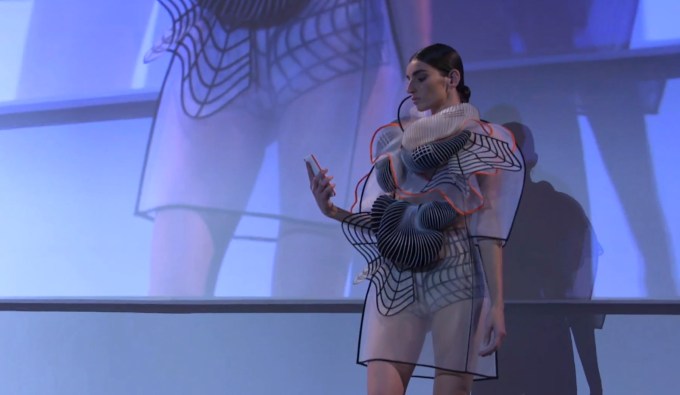
Have a new phone? Better use fashion models to show them off. Because real people wear outfits that look like monochrome jellyfish and never smile and they want… no, need… your products.

That’s just what HTC did today in an industry that is plagued with gender inequality and “booth babe” marketing. They had models of both sexes strut around with phones designed to make it easier to take pictures of models.

Screen Shot 2014-10-08 at 4.37.17 PM
The occasion for this ham-handed event was the launch of the HTC Desire Eye, a phone that features front and back 13MP cameras — you know, for the selfies. Instead of celebrating a fairly amazing achievement, they turned it into a fashion event. And when mobile companies try to put on fashion events, everyone loses.

Technology companies generally struggle to make press events like these interesting. It takes something special to get people to look up from their laptops and phones. Several years ago, Samsung put on a Broadway “show” worthy of a local community theater. But that backfired. It was hilarious rather than interesting. It was roundly derided as ridiculous.

At CES 2013 Qualcomm rolled out the psychedelic elephants and floating deadheads for an event that was clearly designed by someone dropping acid.

And now HTC joins this crowd with a fashion show featuring future Sith Lords. Well done, HTC. At least you didn’t die quietly.

Please, mobile companies, stop. There is nothing “fashion” about your product unless you count the number of celebrities who carry your phone for a week because you gave it to them. Phones are objects of desire, to be sure, but that desire is not manufactured or forced – it’s earned, and this was just a mess.

One In Three U.K. Children Now Owns A Tablet — Instagram, Snapchat, WhatsApp Use Also Rising

Last October research put out by the UK’s telecoms regulator, Ofcom, highlighted rising usage of tablets among kids. Unsurprisingly that trend has continued, with Ofcom’s 2014 annual report exploring parents’ and children’s media use finding that tablet ownership by children in the U.K. has now risen as high as one in three.

Among children aged between 5 and 15, Ofcom found that a third (34%) now own their own tablet, i.e. rather than using devices belonging to their parents or school. That’s up from a fifth (19%) back in 2013.

Kids’ tablet ownership is even rising at the lower end of the age bracket, with around one in ten (11%) children aged 3 to 4 years now having their own tablet, up from just 3% last year.

The 2014 report also notes that twice as many kids aged 5 to 15 years old are using a tablet to go online (42% versus 23% in 2013).

It argues this could have implications for the future use of laptops and PCs — especially given the report notes a drop in the proportion of children accessing the internet on a PC, laptop or netbook. Ofcom says this fell for the first time (since it began this annual survey back in 2005) — dropping by three percentage points, year on year, to 88%.

Meanwhile smartphone ownership among kids has remained steady, according to Ofcom,  with the 2014 report recording that a fifth (20%) of 8-11s own a handset, and 65% of 12-15 year olds.

The report suggests tablets are replacing TV sets in kids’ bedrooms, with the latter proportion dropping by a third over the past five years (from 66% in 2009 to 46% in 2014). Meanwhile the proportion of kids watching TV shows on tablets is on the rise — up by a third in a year, from 15% in 2013 to 20% in 2014.

Gaming on tablets is also on the rise among U.K. kids. It’s up from 23% last year to 30% in 2014. But use of dedicated gaming devices is dropping, down from 81% in 2013 to 77% in 2014.

Kids’ social media usage increasingly diverse

The report also explores social media usage by children in the U.K., shedding some light on the relative popularity of various digital services among this age group.

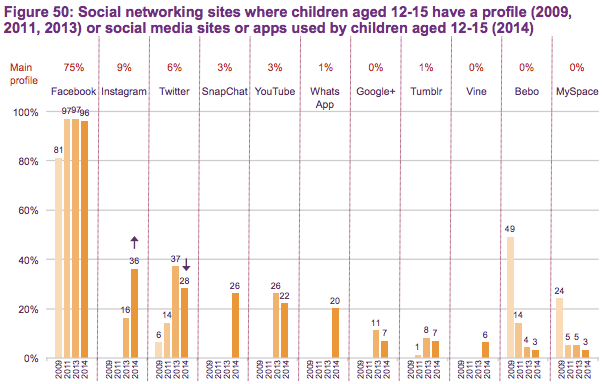
According to Ofcom’s data, Facebook remains a staple for U.K. kids, with almost all surveyed children (96%) reporting they have a profile on the site — a proportion that has remained largely unchanged since 2011.

However the proportion of kids who identify Facebook as their “main social profile” has declined. The report notes that has dropped from 87% in 2013 to 75% in 2014.

Meanwhile other social serviced have bubbled up, with usage of Instagram, SnapChat and WhatsApp specifically all growing since last year’s survey — although their proportional usage lags far behind Facebook. Still, given that the relative attraction of using additional social service to Facebook is likely to be for kids to seek out a smaller niche group of users (i.e. which does not include their parents) that’s to be expected.

Of these additional social services, Instagram has currently carved out the biggest niche among U.K. kids after Facebook — with some 36% of respondents saying they now use the photo sharing site, and 9% identifying it as their main social profile.

That’s followed by 26% who say they use SnapChat, and 20% who are using WhatsApp. Both Instagram and WhatsApp are owned by Facebook, of course. But SnapChat remains independent, having shunned various suitors.

On the falling out of favor front, the Ofcom report shows usage of Twitter among U.K. kids has declined after three prior years of growth, down from 37% last year to 28% this year. While Google-owned YouTube has also dipped slightly in usage, dropping from 26% to 22%.

The report underlines how fickle digital fashions can be among this age group, with erstwhile U.K. kids’ digital social favorite Bebo rapidly falling from a usage rate of nearly half (49%) back in 2009 to a mere 3% in 2014.

Ofcom media report 2014

Monsieur, The Drink Robot, Raises $2 Million

A robotic bartender named Monsieur and his human partners have raised $2 million in seed investment from BIP Capital with Base Ventures, Paul Judge, TechSquare Labs, NFL star Derrick Morgan, and NBA star Glen Davis. The funding will go towards building more Monsieur drink robots for bars, restaurants, and my bedroom.

“We are in pilot with several NBA arenas, one of the top hotel brands that has over ​4,000​ locations, and​ a popular movie theater brand that has over ​500​ locations. Monsieur will be in at least 3 NBA arenas this basketball season. Those arenas have a total capacity of​ over​ ​110​,000 attendees,” said co-founder and CEO Barry Givens.

As you’ll recall, Monsieur launched at TechCrunch Disrupt and is essentially a black box full of booze. You program in a drink – a Manhattan or a Slippery Wapdoodle With A Twist – and the machine mixes the drink in proper proportion and squirts it into a glass. The whole system runs on an Android tablet and a set of pumps and can be upgraded and controlled remotely. You can think of it as a robot bartender that will never talk back and can programmatically buy you a shot.

“The idea came when I was waiting for his drink to come at a popular restaurant chain. He was there with his friends to watch a playoff basketball game and did not get his first drink until halftime. At that moment he realized that there was an opportunity to develop something that could provide consumers with a better experience but also help the businesses get drinks out faster to increase drink sales,” said Givens.

The team has deployed beta units at restaurants and bars in Atlanta and they’re working on partnerships with drink brands and sports arenas. They see this as sort of a “bartender in a box” that staff can roll into a room and let users order drinks without having staff on hand. The system maintains a log of what was served and the venue can ring up a bill at the end of the night. I’ve tried the drinks that pour forth from this delicious machine and I can report that they are as good as human-made libations. Now if they can only replace bar patrons with faceless robots who won’t bother you with long stories about conspiracy theories, I might just be set.

October 5, 2014

Google Reveals ‘The Physical Web,’ A Project To Make Internet Of Things Interaction App-Less

Google’s Scott Jenson, an interaction and UX designer who left the company only to return to the Chrome team last November, has revealed a project underway at the company called The Physical Web to provide “interaction on demand” so that people can walk up and use any smart devices without the need for intervening mobile apps. This would make it possible for users to simply walk up to a bus stop and receive the time until the next arriving bus, without any additional software needed.

The project is an ambitious bet on the future of smart devices. Analysts are predicting explosions in connected devices over the next few years, with Cisco anticipating 50 billion Internet-connected gadgets in action by 2020, and Intel pegging the total at 15 billion by just next year. Google’s project, spearheaded by Jenson, would make it much easier for people to interact with the growing web of connected devices every day.

“People should be able to walk up to any smart device – a vending machine, a poster, a toy, a bus stop, a rental car – and not have to download an app first,” Jenson explains on the Physical Web project page. “Everything should be just a tap away.”

Th aim of the project isn’t just to create something that can be leveraged by Google devices and software, however; it wants to create a standard that can be used by everyone and that is open, like those used for the basic building blocks of the web. A shared standard would definitely help expand the usefulness of connected devices, but Apple has already taken steps towards its own proprietary version of this kind of tech with iBeacon and with its new contextually relevant app suggestions in iOS 8.

Jenson lists some practical applications of the proposed standards on the project page, including parking meters and vending machines that offer quick and app-less payments, universal physical retail shopping experiences and a ZipCar rental system that works via the signs advertising the parking spaces themselves. As for why Chrome is spearheading this effort, the team sees this as yet another web standard, operating as it does beyond siloed native apps.

An accepted open standard is probably still years away, if we ever get one, but the idea of an Internet of Things that doesn’t require even a single centralized software hub like those provided by SmartThings and others is tempting, especially since it democratizes control over the system.

Little Moe Is A Robot That Hunts And Kills Ebola

A San Antonio-based company called Xenex has risen to media prominence recently thanks to their ultraviolet pulse robot called Little Moe. The robot can enter and clean a hospital room in five minutes and destroy the virus by fusing its DNA. You can watch the cute local news piece about the below.

The technology isn’t particularly new. It works by flashing surfaces with ultraviolet light which in turn damages viral DNA. It uses a particularly bright type of xenon lamp that can “can penetrate and damage organisms in unique ways.”

Sadly the robot doesn’t move itself through the hospital like a virus-destroying Roomba. Instead, you place the robot in a room, set up the room type and number, and arm the robot. It then raises its pulsing and starts firing UV light into the room.

Medical robotics is a big business and it is changing daily. While telemedicine and the like get all the ink, robots like Little Moe are important because they do one thing and they do it very well, in this case room disinfection. And if a cute name and an Ebola scare are what it takes to move medical science forward, I’m all for it.

Skylanders Trap Team Review: Good Storytelling And Simple RPG Mechanics Succeed

The ‘Toys to Life’ category has been a much-needed savior for the gaming and toy industry alike, bolstering sluggish sales for both by anticipating a huge demand for real-life action figures that can be ‘brought to life’ for use in digital games. Activision’s Skylanders series pioneered the concept, and the originator is back with Trap Team, a new installment with the unique game mechanic of allowing players to ‘trap’ key villains in special physical play pieces, which makes them playable in-game as characters.

That’s not the only trick Skylanders Trap Team has up its sleeve, however – the game is being billed as the first to launch simultaneous, completely identical games on both tablets and dedicated gaming consoles. Trap Team is available as a starter pack either for the standard Wii, PlayStation and Xbox consoles you know and love, or for the iPad 3 and higher, along with select Android and Kindle Fire tablets. The tablet version works across devices from various manufacturers, and comes with a Portal and dedicated controller that both use Bluetooth LE to connect, and are battery-powered so you can use them anywhere.
Chompy Mage_Screen

Skylanders developer Toys for Bob assured me, during an interview with founder Paul Reiche, that there was no time at which they felt they needed to cut features or rein in their ambitions for the project in order to deliver a satisfying experience on both iPad and console, and one that offered the full experience in both places. I tested the game both on PlayStation 4 and iPad mini with Retina Display, and it definitely seems like the same thing on both, with a few caveats.

On iPad, you have to download new content like additional Skylander characters and some worlds and environments, while on the console everything is instantly available. This can be either mildly or very annoying, depending on your connection speed, but even with my fast home Wi-Fi some things took longer than others. The waiting is made less annoying by the fact that once you’ve downloaded something, it’s available and loads quickly the next time around.

What’s great about the iPad version is that Vicarious Visions, the team behind the mobile app for Trap Team (and sister studio to Toys for Bob) has delivered a near-perfect mobile gaming experience, in that it can work as either a completely contained title with just the tablet and software, or expand into something a little more robust with the accessory Portal and controller hardware. Vicarious Visions co-founder Karthik Bala explained in an interview that designing an experience that required nothing else, and that could be easily packed up, moved and used anywhere was a key part of their vision for Trap Team for tablets.

STT_Tablet_Lifestyle Photo 1

With an iPad mini with Retina display, I could use the entire Trap Team setup on my desk next to my workstation with little to no interference on my main screen, and aside from some aesthetic differences I noticed (fewer background assets, mostly), the tablet experience was the same as the one on the PS4. My saved games didn’t cross both, but character progress did (it sticks with the toys, of course) and you can still enjoy both versions at the same time.

As for the game itself, it’s my introduction to the Skylanders series, and I have to say I was impressed by both the storytelling, and the level of quality when it comes to character animations is fantastic. Skylanders actually beats some of its rivals with more experience in animated storytelling, like Disney, when it comes to the cutscenes and overall game progression, and the humor and likability of its characters.

The gameplay is repetitive and simple, but then again, this is a title aimed primarily at the 6-12 age bracket, and the puzzles it does provide are just complex enough to avoid coming off as insulting. The fun is in the grind, for more advanced players, and in levelling up your Skylanders to the cap of 20, along with unlocking their powers along the way. One knock against Trap Team is that it doesn’t up the level cap beyond what was introduced in last year’s Swap Force, and older Skylander toys don’t get improved abilities. The game also requires you to use the new Skylander Trap Master figures to unlock a good chunk of the game’s extra content, which means you’ll have to invest in new toys as a completionist, but then again these are mostly Hats and accessories and don’t take away from the core experience.

Playing as villains is a nice, but mostly shallow experience in Trap Team, with no progression available for the baddies. But the idea of redeeming them and their ongoing narration via the Portal’s speaker is charming, and each at least has a sidequest that can “evolve” the character. Activision has also shown some welcome restraint, here: you don’t need a separate trap for each villain, just one of each elemental type, and you can shuffle character off and on to those.

Short Cut_ScreenSkylanders Trap Team ends up being a game that’s fun to play, either alone or with a friend, that just so happens to also encourage a huge amount of accessory purchasing. I’m of the school of thought that if you’re going to be buying toys for your kids anyway, they might as well have some lasting value (Activision once again says these will be forward-compatible with new software in the series). And while I value the appeal to my nostalgia and existing habits that Disney’s Infinity series, and especially its new Marvel line bring, the work Activision is doing creating entirely original IP and weaving it into an actual narrative is impressive. If you’re a fan of the series, Trap Team won’t disappoint, and if you’re new to the game, this is as good a jumping off point as any.

Keep Calm And Attend Hardware Alley In London

It’s Hardware Alley time again and we want to see you at Disrupt London! The alley, which runs during the last day of Disrupt, features all of my favorite startups – the hardware ones – in glorious Technicolor.

What is Hardware Alley? It’s a celebration of hardware startups (and other cool gear makers) that features everything from robotic drones to 3D printers. We try to bring in an eclectic mix of amazing exhibitors and I think you’ll agree that our previous Alleys have been roaring successes.

We’d like you to register as a Hardware Alley exhibitor. You’ll get to exhibit on the last day of Disrupt London, October 21, to show off your goods and get access to some of the most interesting people (and most interesting VCs) in the world.

All you need to demo is a laptop. TechCrunch provides you with: 30″ round cocktail table, linens, table-top sign, inclusion in program agenda and website, exhibitor WiFi, and press list.

You can reserve your spot by purchasing a Hardware Alley Exhibitor Package here.

If you are Kickstarting your project now or bootstrapping, please contact me at john@techcrunch.com with the subject line “HARDWARE ALLEY.” I will do my best to accommodate you.

Hope to see you in London!

StoreDot Charges Up With $42M For Its Fast-Charging Bio-Organic Batteries

Israeli startup StoreDot, which is developing quantum dot-utilizing fast-charging smartphone battery technology, among other things, has closed a $42 million Series B funding round. It pitches its bio-organic nano-crystal technology as an enabler for faster charging batteries and also a cheaper and non-toxic alternative to cadmium in screens.

StoreDot demoed the speedy charging battery technology back in April, flaunting its potential with a prototype device that charged from flat to full in 30 seconds — although it used a less than full capacity battery that was too large to fit inside a phone.

Commercializing this technology will require applying it to a full capacity battery and squeezing everything to fit inside a standard smartphone — and that’s what it intends to use the new funding round for, it said today.

Speaking to TechCrunch, StoreDot’s CEO and founder Dr Doron Myersdorf said: “The fully functioning prototype that fits inside the phone for commercialization will be ready the second half of 2016. In early 2017 it will be on the market.”

Also on the slate for StoreDot post-Series B: new hires, and developing other technology products that make use of its nano crystal bio-organic technology. To that end, it said it sees potential for its technology to enhance various electronics areas — including superfast Flash memory and bio-lasers (i.e. in addition to batteries, displays and bio-LEDs).

Other use-cases for the tech it’s looking at are in an area it terms “nano-medicine” — citing “drug delivery, food security, bio labeling and more” as areas of interest here.

Medical uses are not surprising, given that StoreDot’s technology was actually spun out of research being done into Alzheimer’s disease at Tel Aviv University. That research identified particular peptides (amino acids) that the startup is utilizing for electronics.

“When the self-assembly process of these molecules can be managed, we can create nano-crystals,” said Myersdorf back in April, discussing how the technology works. “We were able to take the same peptides that participate in biological processes in our body and to create nano-crystals — these are stable, robust spheres.

“And these can be used… in a semi-conductor device or in a battery or in a display. We are talking about new type of materials that can be introduced into different types of devices.”

Investors in StoreDot’s new funding round are largely undisclosed, with multiple unnamed “strategic partners” cited in a press release. (Samsung has previously been rumored to be an investor in the technology but a StoreDot spokeswoman declined to comment on this.)

The round does include a confirmed $10 million investment from Russian businessman Roman Abramovich’s private asset management company, Millhouse LLC.

StoreDot had raised a total of $6.25 million before this Series B round, with prior investors including Singulariteam, a private investment fund focused on early stage startups.

Myersdorf previously told TechCrunch StoreDot was hoping to close a $20 million Series B so it has evidently been able to boost the size of the round considerably — given today’s announcement of a $42 million closing. The size of the round will enable the startup to commercialize “both the fast charging battery for smartphones and our BioLED display”, he added in a statement today.