Pages

November 12, 2014

Amazon Is Expanding Its R&D In Cambridge, U.K., With A Focus On Prime Air Drones And Speech Tech

Amazon is expanding its R&D operations in Cambridge, U.K., with a plan to staff out a large research lab — expanding on the foothold it acquired when it bought Cambridge-based speech tech startup Evi Technologies two years ago, TechCrunch has learned.

Cambridge is feted for its world-class university which, in turn, acts as a hub for concentrating science and technology talent, naturally leading to many startups spinning out from it. Amazon is evidently hoping to grab itself a larger slice of this local talent. A source familiar with the company’s plans told TechCrunch it will focus on Prime Air, its autonomous delivery drones project, and on beefing up its speech tech R&D team.

The e-commerce giant has been staffing up for Prime Air over the summer, including seeking hires in Cambridge. It has continued advertising for Prime Air positions in the U.K. university town this fall, including a Flight Operations Engineer role posted this month, a Site Leader role posted in October and a Senior Research Scientist role posted in September. The latter asks for “experience applying machine learning approaches to complex problems,” among other skills.

Amazon’s expanded Cambridge presence will also see it tool up its speech group significantly, tapping Cambridge’s pull and talent pool here too. Job roles Amazon is currently hiring for under an Evi Technologies Limited company listing include a Quality Assurance Engineer, a Senior Technical Program Manager and various software developer roles.

One software dev testing role job ad notes: “Our testing involves verifying a rapidly changing and growing knowledge base answers our customers’ questions as quickly and accurately as possible across many different services.” Another role within the same Evi hiring group refers to working on “brand new projects using cutting edge technology.”

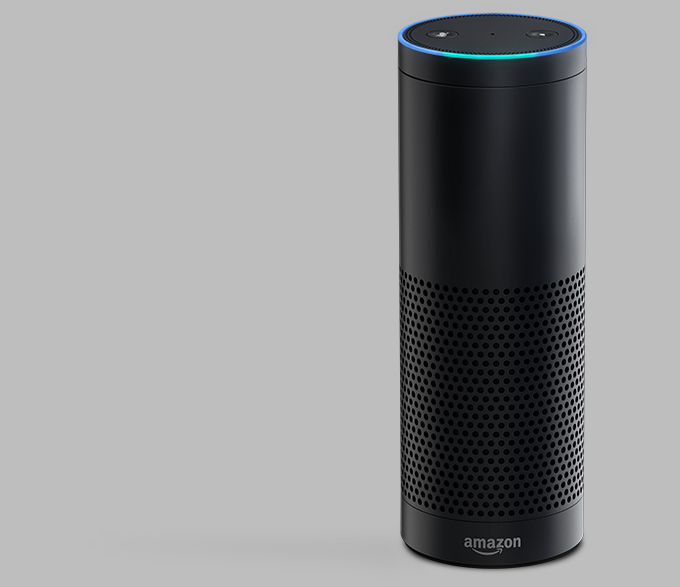
Why speech tech? Earlier this month, Amazon unboxed Echo: a connected speaker with an always-on, voice-activated assistant linked to other Amazon services, such as streaming music playback. So it’s not a huge leap to see Amazon pushing Echo into a fully fledged voice-activated shopping portal, with making a purchase made as frictionless as saying “order me Taylor Swift 1989″ — assuming the voice-recognition technology in question is up to snuff. Hence Amazon ramping up its R&D in speech recognition.

amazon-echo

Other possible research areas that could play to Amazon’s retail interests, and that have existing researchers and startup players located in Cambridge, include computer vision technology and augmented reality — technologies that offer to spice up the online buying experience in other ways.

Amazon is not the only tech giant that’s been connected to Cambridge recently. Earlier this week Apple was linked with the city, with rumors suggesting the company might be looking to establish an office there, possibly with an R&D component. Google has also previously been rumored to be interested in setting up a base in the city, although TechCrunch’s source suggested Mountain View’s interest in Cambridge may have waned for now. Other tech giants already have long established R&D labs in the city, including Nokia and Microsoft.

We’ve asked Amazon for more details on its plans for its expanded Cambridge research lab and will update this post with any response. Currently the company lists U.K. development centers in London and Edinburgh, working on digital media R&D and new technologies for its global websites, respectively.

Should Microsoft Build Hardware?

So what’s this new Microsoft strategy you’ve been hearing about?

According to CEO Satya Nadella, the company is three things: Office 365, Windows and Azure. “That’s it,” the executive recently quipped. Given that narrow focus, how do the company’s massive and recent bets on hardware fit into the picture?

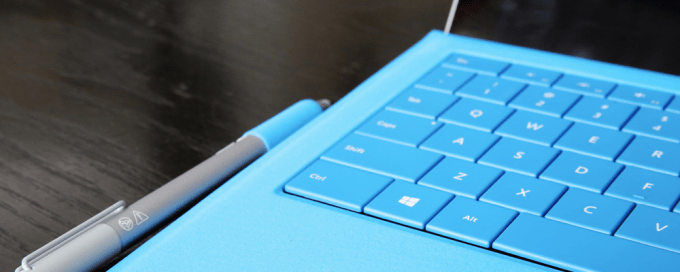
Microsoft has poured billions in its Windows Phone project, even before you take into account its purchase of Nokia’s hardware assets. And Surface has been a damn expensive project, though one that has been showing some stronger signs of life in the most recent quarter.
Screen Shot 2014-11-11 at 12.49.02 PM

We recently sparred over whether Microsoft’s hardware strategy makes a wit of sense. Should the company get out of the hardware game and go all in on services or does its hardware play make sense — especially since it’s put so much money into it?

Ron Miller is up first:

If Microsoft Wants To Be A Services Company It Needs Total Focus

Microsoft has been making moves lately that suggest it wants to be a service company, but if that’s the case, it’s going to take total focus.

For example, last week, Microsoft surprised some people when it announced a deal with Dropbox to embed Dropbox storage inside of Office and allow Dropbox users to edit documents from Dropbox. Microsoft has services that do this, and the old Microsoft would have protected that internal business over any other business opportunities. But this isn’t the old Microsoft. It’s the new service-focused Microsoft and it intends to go where the users are, regardless of what impact that has on its own products.
Screen Shot 2014-11-11 at 12.53.00 PM

In another example, this spring Microsoft announced a deal with Salesforce.com around its CRM tool. Once again, Microsoft has a CRM service in Microsoft Dynamics, but it ignored its own products, because it wanted to put the platform over the product (or the many over the one as Spock might say).

If you’re beginning to sense a pattern here, you’re absolutely correct. As my colleague Alex pointed out in a series of posts recently, Microsoft is trying to get leaner and more focused, so it’s putting its eggs in one of three baskets: Windows, Office 365 and Azure — a core OS, a software service platform, and an infrastructure platform, respectively. That’s it.

It’s actually a brilliant plan if they stick to it, but they seemingly can’t let go of some things that are getting in the way of succeeding.

If those three pieces are truly the core of this new Microsoft, they need to get out of the hardware business because it doesn’t really fit any of those buckets, does it? When you look back at Microsoft’s hey day, it was successful (all antitrust business aside) because it concentrated on what it did well.

It was a Windows/Office business with some nice enterprise pieces such as Windows Server, Exchange Server, Active Directory and so forth. What you didn’t see was Microsoft-branded PCs and servers. Microsoft created a core set of products and let everyone build stuff on top of that and it was tremendously successful. They fed the hardware and software ecosystem and didn’t try to compete in any direct way with their OEM channel.

(And yes I know they made keyboards and mice, but that was a small part of the business.)

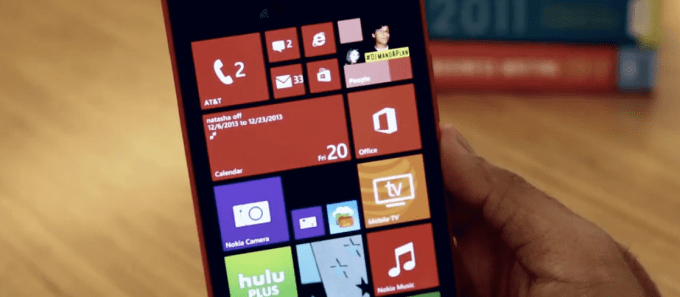
Today, Microsoft is trying desperately to sell phones and tablets. It has no business doing that if it truly wants to stick to that core mission. Sure, the numbers have gone up nominally last quarter and every Microsoft fan let out a loud cheer and let everyone know it, but ultimately when you look at the numbers, Microsoft isn’t even on the radar of companies like IDC who track tablet sales and they barely register on the phone side.

What’s the point of wasting time and resources producing these devices if they aren’t central to the services mission, and they aren’t central to that mission. You could argue of course that Microsoft needs these devices for its mobile strategy to work, but what it needs is to get more hardware companies interested in the platform and the services that run on it.
Screen Shot 2014-11-11 at 12.49.15 PM

And as for Xbox, yes it’s much more successful in its market, but it has absolutely nothing to do with the core mission. Sorry. I don’t see a place for it in the new Microsoft and if Microsoft were smart, they would spin it off or sell it.

As R Ray Wang from Constellation Research told me last spring after the Microsoft-SFDC announcement, for Microsoft everything now comes down to the platform. “If you view Microsoft as a platform company, they will make decisions [from now on] in the interest of the platform,” Wang told me at the time.

And if that’s true, Microsoft needs to get out of the hardware business, and soon.

Next up, Alex Wilhelm:

You Don’t Back Half A Horse

Ron is correct to state that Microsoft is a services company now, or at least a company that has charted a path in that direction. I don’t completely disagree with his analysis from my own perspective, but I do think that there is a bit of a dissonant nuance at play when you take into account Microsoft’s broader strategy, as best as I can understand it.

Broadly, I think that hardware can be viewed in a support role to the company’s primary efforts, and that the company is pretty well pot committed, to a certain extent. Also, the company is finally seeing cracks of sunlight in formerly dim financial results.

First up, the three core points of Microsoft appear to be set: Office 365, Azure and Windows. Microsoft CEO Satya Nadella recently stated that he views Windows 10 as a service, so that makes the company’s three core efforts each land decidedly in the services column.

Hardware fits into this in three ways: Without its Windows Phone business, there is no Windows Phone-as-a-platform. If it abandons Surface, it would leave behind a nearly profitable business that does a fine job showcasing Windows, and provides a template for its OEM partners to build better hardware; and if it did drop hardware altogether, it would greatly deprecate its gaming efforts.

Screen Shot 2014-11-11 at 12.52.51 PM

Why would it matter if there is no Windows Phone, given the hardware line’s limited sales, when compared to iOS and Android? It appears that Microsoft is betting that when Windows 10 comes to fruition, and Windows Phone becomes a full member of the Windows family, it wants to make a developer proposition that extends from the smallest screens to the largest — build once deploy everywhere I’d think works better when your “everywhere” is largest.

A short aside to gaming here is useful: Gaming is the largest and most popular category of apps on Windows Phone. If Microsoft walked out of the hardware game, there would essentially be no Windows Phone handsets in the market, and thus there would be no Windows Phone unit volume, and thus sales and downloads of games would begin an inexorable decline. So, if Microsoft leaves hardware, attention from gaming developers that it wants very much for Windows 10 would be cut. That would be tough.

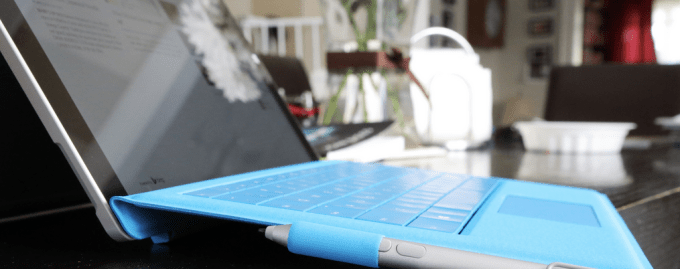
Moving forward, regarding Surface, I agree that if the business had failed to produce a better-selling device in the Surface Pro 3, the project would have been a decent candidate for cancellation, simply because it had minor revenues — when compared to the larger Microsoft top-line segments — and therefore less importance. Also keep in mind that Surface, in terms of unit volume, is a slim slice of total PC volume, making it not mission critical for the PC market in terms of short-term survivability. However, the Surface Pro 3 has done two things: Grown Surface revenue greatly while moving closer to GAAP profitability, and has provided a reference design for how to build touch-PCs that are useful in the Windows 8+ context.

Given that, why cut it loose? The company expects sequential quarter unit volume growth it said in its earnings, so we could see even higher revenue in the current quarter. Why cut a nearly profitable business that could do more than $3 billion a year in top line?

Regarding Xbox, the chance that Microsoft does away with it is nil to begin with, but it is worth noting why: It has massive buy-in among younger users that might not otherwise have lots of experience with Microsoft products, which could help the company gain mindshare among the people down the road that are likely to buy computers.

And again, the gaming bit: If Microsoft dropped its Xbox business, it would greatly harm its relationship with gaming companies, firms that will be able to quickly and easily deploy their titles across the unified Windows 10 platform, where the company would love to see popular Xbox titles land to help support the unified Windows Store.

Surface almost makes money, Phone will lose money for only another fiscal year or so, and Xbox is a hit for the company. And, given that each supports the key coming Windows 10 platform, and leans on the company’s Azure computing service — making them useful customers, if in-house — I don’t think that they are on the chopping block.

If gobs of money are hemorrhaged, expect cuts. But for now, Microsoft has spent something in the neighborhood of $10 billion — using back of the envelope math — on buying Phone, Phone losses and Surface losses, not to mention Surface development costs pre-launch. You just don’t throw that away.

Don’t aQuantive things that might work, bro.

Featured Image: Microsoft

TC Droidcast Episode 26: Moto Rules With Droid Turbo And Nexus 6

This week’s Droidcast features Darrell Etherington, Chris Velazco, Greg Kumparak and Kyle Russell, and we discuss the looming Nexus 6, as well as more Motorola with the Verizon-exclusive Droid Turbo. Also up for debate are the merits of Samsung’s own-review of the Gear S, which heralds a new low in content marketing, and the Chromecast’s ability to play games, and whether people will ever do that in any sizeable numbers.

Generally speaking, we’ve got lots to discuss next week with more detail on the Nexus 6, as well as Android Lollipop and how it works on phones, but email us directly if you have a suggestion for something to cover on the show.

Subscribe on iTunes and check out past episodes directly on TechCrunch.

Download it directly here: http://traffic.libsyn.com/droidcast/droidcast-26.mp3

Halo: The Master Chief Collection Review

Halo: The Master Chief Collection collects all of the existing Halo games that feature Master Chief as the main protagonist, including the original Halo: Combat Evolved, right up through Halo 4. You can play the games in a number of ways, by either going through each campaign as they were originally designed in a linear fashion, or by jumping into any mission of your choosing directly, or by playing through custom-built playlists of levels from each title designed to focus on highlights.

First off, I take for granted that anyone who seriously loves Halo will pick this up. It’s a must-have for Halo fans, but that’s a given, and Microsoft didn’t need to do much to convince that group to buy anyway. The thing is, work has been expended and attention has been paid, and this box set is much more than a simple repackaging of what was already available separately.

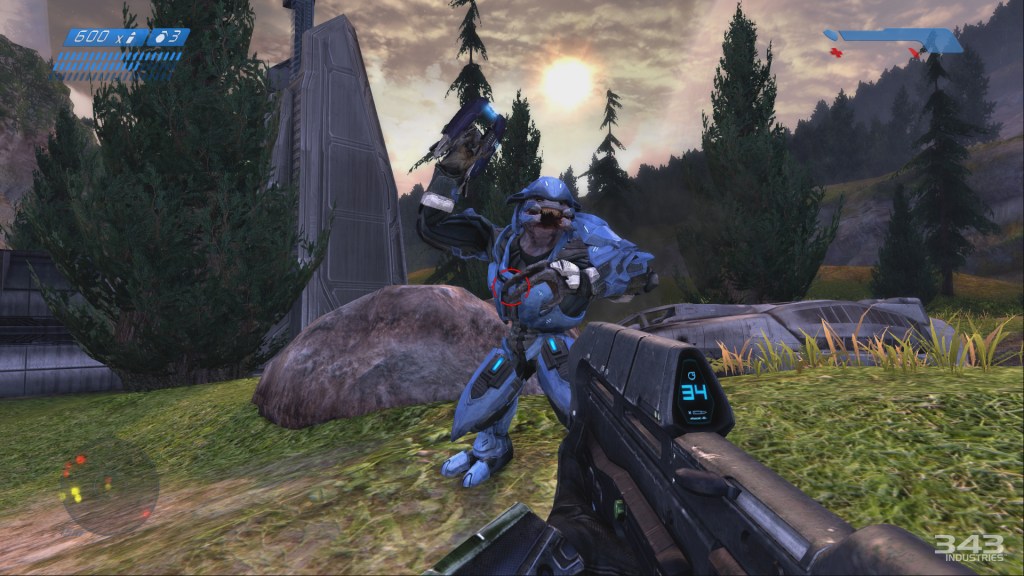
TMCC-Halo-CE-Anniversary-Halo-The-Dance

There’s the graphics overhaul, of course. The curious effect of these reskinning of old titles is that you tend to forget what they looked like previously, and since our imaginations are powerful things, they can trick you into thinking the HD remakes of original titles actually don’t make that much of a difference. The Master Chief Collection anticipates this, and provides a button that lets you switch back to the original graphics engine, which illustrates just how much work went into creating new and improved textures that look at home on next-gen hardware like the Xbox One.

The entire experience is made better by the improved graphics, but it’s a special treat to be able to enjoy multiplayer maps from games of old with glorious new visuals. Multiplayer here will be a real treat to fans of the series, as each game inherits its specific multiplayer engine, with the added benefit of being able to run each title in four player split-screen local combat mode. This makes for some amazing nostalgic gaming sessions, taking me right back to any number of high school classmate’s basements. You can almost smell the pizza.

TMCC-Halo-2-Anniversary-Regret-Blockheads

Halo’s overall appeal remains the same as it has always been – great gaming experiences, including co-op fun and a single player campaign that, while it acts as a distraction from the main multiplayer show for many, still holds up with a fun, and sufficiently rich narrative storyline, as well as gameplay that while repetitive, doesn’t somehow manage to get boring. The Master Chief Collection recaptures all the original appeal of each title in the series, but manages to add something new into the mix as well, both through updated visuals, through the unique remixing of existing content, and through additional content in Halo 2: Anniversary that points to what’s to come in Halo 5: Guardians.

Microsoft’s software goal this holiday is evident, between this title and Sunset Overdrive: Bring new buyers to the Xbox One. Halo: The Master Chief Collection does so by appealing to things fans already love about Microsoft and its past successes, while Sunset Overdrive appeals to a crowd that might not necessarily be swayed by a chance at a second dance with the Master Chief. The Halo compendium is strong regardless of its motives, however, and should indeed convince some fence-sitters to come back to the fold. Plus, if you’re new to the series, then I envy you the experience of playing through this collection.

Flux’s 3D Printer Is Also A Scanner, Laser Engraver And More Thanks to A Modular Design

3D printers are at a bit of a crossroads – after a lot of initial promise, they seem to have hit a roadblock between early adopter zeal and general consumer interest. A new entrant called Flux should at least reinvigorate hobbyist excitement, thanks to a modular design that makes it a veritable all-in-one maker factor for budding builders. The Kickstarter project for Flux launches today, making the gadget available for pre-order pledges starting at $499 for an early bird unit reservation, and $599 after that.

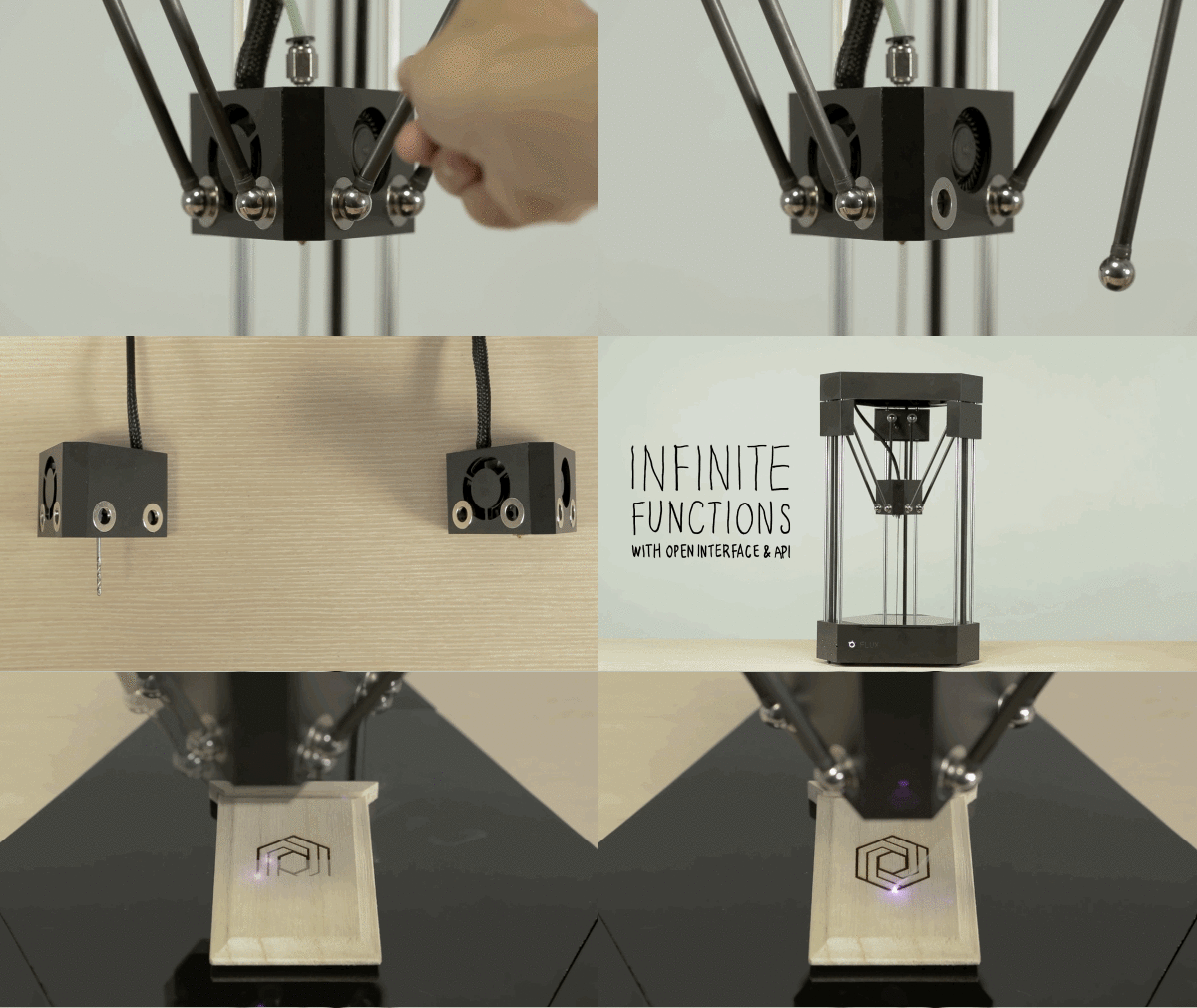
Flux’s modular units allow it to become a 3D scanner, later engraver, ceramics or pastry printer using modules either included, available as a separate add-on option or in development for later release. The startup has also opened up a module SDK to let others build hardware add-ons to potentially create lots more different capabilities for the Flux system in the future.

Aside from its modularity, Flux has other advantages over other systems, according to its creators, including simply setup right out of the box, higher repairability due to its modular design, Bluetooth-based mobile device control and operation, user-friendly modelling and configuration software, and a desktop-friendly design that both saves space and looks good.

8c0133eaad259d4c5252960328e12902_large

From a very basic standpoint, the Flux looks like something I’d be much more likely to own than any other currently available 3D printer on the market  – price aside. The fact is that most of the time I’d probably much rather have a laser engraver than a 3D printer, and the potential of other similar modular units that could offer other kinds of 3D material manipulation, like a touch-sensor testing unit, for instance, or any number of potential add-ons, mean Flux could eventually act as a near-complete micro prototyping lab for home use.

Taiwan-based Flux includes a young team of entrepreneurs, but already 30 fully functional prototypes based on a combination of open source technology and proprietary design have been created, and the team’s funding goal of $100,000 is designed to bring them through to the mass production phase. The first round of devices for backers should start to reach backers in July 2015, according to the teams’ projections.

The Rise Of The Sensornet: 4.9BN Connected Things In 2015, Says Gartner

Gartner is predicting a 30 per cent jump in the number of connected objects in use in the wild from this year to next as sensing connected devices proliferate in an Internet of Things (IoT). In a forecast put out today, the analyst predicts there will be 4.9 billion connected things in use in 2015, up from 3.8 billion this year.

The boom in connected sensing devices will gather pace, with the analyst predicting some 25 billion smart devices in circulation come 2020. In other words, hold onto your breath-sensing seats.

For a little comparative context on the figures, annual smartphone shipments topped 1 billion for the first time at the start of this year, based on IDC’s numbers. Connected things can of course scale much faster than smartphones, being far less complex and having a fraction of the per unit cost.

Gartner expects the automotive sector to see the highest growth rate of installed IoT units in 2015, pegged at 96 per cent, outstripping business and consumer sector growth.

Gartner

The industry verticals driving the IoT next year with the most connected things in use will be manufacturing, utilities and transportation, according to Gartner, which reckons they will collectively have 736 million connected things in use.

By 2020 the mix will shift, with utilities topping the list (thanks to investments in smart meters), followed by manufacturing and then government in third place, comprising a total of 1.7 billion IoT units installed. Government rises up the list thanks to predicted investments in smart street and area lighting for energy reduction purposes.

Gartner characterizes the Internet of Things as a risk to many existing businesses, combined with other digital accelerators such as cloud, mobile and social, and argues that companies will therefore be driven to adopt connected devices, as they were forced to accept the consumerization of IT.

Within the next few years it reckons some level of built-in intelligence and connectivity will be regarded as standard — and will rapidly filter down to mainstream products and services, creating new business models and value propositions. So either a threat or an opportunity, depending on your view.

Startups building connected devices are already in abundant supply, boosted by rapid prototyping technologies such as 3D printing and access to crowdfunding to turn a concept into a shipping product at relatively low cost. But this is just the vanguard of the sensornet.

Security in the spotlight

Another area set for change as a result of the rise of the IoT is security. Gartner notes how connected devices highlight what it dubs the “tight linkages” between information security, IT security, operational tech security and physical security “like never before”.

It argues this means enterprises will be faced with executive decisions about the ownership of security within the business — so who governs, manages and operates it. Gartner predicts that by the end of 2017 more than a fifth of organizations will have digital security services devoted to protecting business initiatives using devices and services in IoT.

It adds:

The IoT will bring into the digital security architecture dozens of new platform options, hundreds of variations on hybrid IT/IoT integration, new standards per industry, and a new view of an application. IT leaders will have to accommodate the differences in technologies across those areas and develop a multifaceted technology approach to IoT risk and security. In addition, with some machines producing enormous amounts of data and other sensors sending a handful of bits per day or week, IT leaders will need to balance digital business requirements with digital security realities.

To Hit Fast Forward On The Internet Of Things, Get Personal

Editor’s note: Charles Huang is the COO of Leeo.

Try asking your parents or any friends who live in the suburbs what “IoT” or “smart home” means, and more often than not, you’ll get a blank stare in return. In Silicon Valley it seems like technology is ingrained in every aspect of life, but to the rest of the world, the question still remains, “Why do I want or need that?”

In order to get to the point where smart-home technology is ubiquitous, I’m convinced IoT products must go beyond today’s focus on just improving efficiency or adding more complex features and functionality to the latest gadget, and instead offer simple, clear use cases, and connect to people on a more meaningful and personal level.

Here’s what I mean: A friend told me that his house alarm had gone off for 30 minutes and none of his neighbors called the police — dumbfounding the officers who eventually arrived. But what if that alarm didn’t just send an alert to some nondescript entity that might (or might not) react in time? What if the alarm were connected to neighbors who’ve agreed to watch over each other? Even better, what if the alarm also helped to connect us to the local police, fire departments and emergency medical teams?

IoT technology allows us to build and even extend these bonds in important new ways, so that even when I’m not nearby I can still help the people in my designated community. My brother can let me know his son is alone, for example, and I’m in a better position to help because his house has cameras or sensors that talk to my IoT devices. Motion sensors on the doors of my grandparents’ home can tell me if they’ve stopped moving, so I can have a neighbor check on them. Clinics can monitor, and immediately respond to, at-risk patients living at home.

This call to action is much more powerful than squeezing out more efficiency or saving a bit more money — the main priority of the current crop of IoT products. Don’t get me wrong. Helping people make smarter choices about non-renewable resources will be a huge boon to the health of our planet. But IoT technology allows us to do so much more because it encourages us to look for and care for each other in ways we’ve never imagined. That’s incredibly powerful, and it’s what makes IoT such a game changer.

And that’s why companies entering the IoT market need to think beyond what the machine can do and instead think about what humans need and desire. It always starts with understanding humans as broadly as possible and what they really want. At Guitar Hero, we tried to sell fun. We then asked ourselves “What circumstances lead to the most fun?” We realized it’s when people have friends and family over. In the IoT market, we have to ask questions that are a layer or two deeper, and apply technology to achieve those aspirations.

But by asking those questions first — how to create a product that lets people feel they are healthier, smarter or a better parent, for example — we have a much more interesting starting point. We can then explore the kind of community — the relationships between people — that will strengthen those bonds.

The Internet of Things makes it possible to empower people as few other technologies can. It’s one reason analysts expect this market to be huge. IDC, for instance, estimates $7.1 trillion in worldwide spending by 2020. Cisco Systems suggests a $14.1 trillion market by 2022.

The ultimate dollar size almost doesn’t matter. (What’s a few trillion between friends, anyway?) It’s the “when” that interests me. Putting the focus back on the people whom this technology can serve — rather than just the technology for its own sake — will help to fulfill the promise that the IoT market holds.

Featured Image: Dan Bruins

The Rosetta’s Philae Probe Makes History, Successfully Lands On Comet 67P

In an historic mission that has taken more than a decade, the European Space Agency has successfully landed a probe called the Philae Lander on a comet called 67P, marking the first time a space craft has ever successfully landed on the surface of a comet.

The probe, which has its own Twitter account, tweeted that it had a new address on 67P.

The space probe weighs about 250lbs and was ejected from spacecraft Rosetta about seven hours ago, falling at a slow speed due to the gentle gravitational pull of the 2.5-mile-long comet. At one point during the first-of-its-kind mission, one of the thrusters on Philae wasn’t working properly and was feared to be an obstacle in a successful landing.

But, all’s well that ends well.

Rosetta took ten years to reach 67P. It had to orbit the earth three times to build up enough momentum and speed to catch up, and then go into a hibernation mode to conserve power, until finally reaching the comet and ejecting probe Philae.

The ESA has confirmed that they are receiving signals from Philae, and that harpoons used to land and anchor the probe have been successfully fired and reeled in Philae.

Update: It’s unclear what happened with the harpoons. Philae definitely landed, but the ESA tweeted that the harpoons fired and reeled properly and Philae tweeted that they did not. Mysterious.

This mission and its success is significant because comets are hunks of planet that are hurling through space, and likely contain information about complex molecules that may contain the building blocks for life.

Philae’s lead scientist Jean-Pierre Bibring told The Verge that “comets have the beauty of having preserved the ingredients with which the solar system formed,” and that 67P’s ice may contain the building blocks for life.

Now that it has landed, Philae will conduct experiments for approximately 60-hours at full power before its battery is depleted. Solar panels will recharge the probe, as long as it hasn’t landed in a shadow.

You can follow along as the story develops here and we’ll be updating you as we learn more.

Also, look at this sick photo taken on Philae’s way down to the comet:

Screenshot 2014-11-12 13.24.41

November 3, 2014

This Ambulance Drone Can Fly Into Trouble With First Aid

A Dutch engineer has created a flying defibrillator for emergency situations. The drone, called the Ambulance Drone, would be stationed at various points in the city. In an emergency, people on the scene can call it in and it arrives a few seconds later. The built-in defibrillator unit can be used by anyone and it allows doctors to monitor the situation after the shocks are administered.

The drone includes a webcam and loudspeaker and allows remote doctors to walk people on the scene through the process of attaching the electrodes and preparing the defibrillator. The creator, Alec Momont of TU Delft’s Faculty of Industrial Design Engineering, said that 20% of people can operate a defibrillator without instruction and the number rises when they have prompts from trained personnel.

‘Some 800,000 people suffer a cardiac arrest in the EU every year, and only 8% survive,’ Momont explains. ‘The main reason for this is the relatively long response time of the emergency services (approx. 10 minutes), while brain death and fatalities occur within 4 to 6 minutes. The ambulance drone can get a defibrillator to a patient inside a 12 km zone within one minute. This response speed increases the chance of survival following a cardiac arrest from 8% to 80%.’

The system is still in prototype stage but there is a good chance it could be launched in five years for about $20,000 each. Drones are still not allowed to fly autonomously so they can’t wing their way around downtown Delft with their helpful payload… yet. It will be interesting to see these robots flying around one day, dropping first aid when needed.

Jony Ive Is So Focused On Design He Doesn’t Know Apple’s Key Financial Numbers

Apple design lead Jony Ive spoke to an audience at the San Francisco Museum of Modern Art last night, the Wall Street Journal reports, addressing the difficulties in designing an Apple smartwatch. The Apple Watch design process was “difficult and humbling” because of the expectations consumers have with regards to wearable tech and fashion, Ive said, but perhaps his most interesting comment was about his lack of awareness when it comes to Apple’s top and bottom line financials.

Ive made a point about Apple’s focus on product design above other concerns, suggesting that the company is worthy of applause for embracing the ethos that products come first, and profits will follow. To drive home his point, Ive made the surprising confession that he’s not familiar with the actual numbers Apple announced during its most recently quarterly earnings, including its annual revenue of $183 billion, or its $40 billion in profit for its fiscal 2014.

“I honestly don’t know the numbers,” Ive remarked, per the WSJ. “But I know they are high.”

Though Ive professing not to have specific knowledge of the company’s financials might seem odd for a high-level executive reporting directly to the CEO, the celebrated designer is known for his focus on product design, and the fact that he doesn’t pay that much attention to the company’s fiscal performance is a credit to the company’s long-stated belief of putting product before a desire to make money, with the argument being that customers will reward top-quality device design.

Of course, the luxury of being able to focus entirely on product design and ignore money issues is also one afforded pretty much exclusively to companies that are doing well, so it’s not that surprising Ive is able to keep his head down in the studio.

The Apple Watch is set to debut early next year, and Apple is pushing it heavily in fashion circles, including with an editorial photography spread in Vogue and a special preview event in Paris during Fashion Week. It might be the Apple product whose fate rests most heavily on Ive’s shoulders, too, given how much attention has been paid to its design chops so far, and how important design is to a device that’s meant to be worn almost around the clock by its users.

Featured Image: Screenshot

GoPro Shares Spike As It Handily Beats Street Estimates

GoPro’s earnings for the third quarter were pretty as a picture for the company’s investors, with earnings coming in above analysts’ expectations

For the quarter, GoPro racked up sales of $280 million, up 45.7 percent from the $192.1 million reported in the third quarter of 2013. Adjusting for generally accepted accounting principles (GAAP), profits were $14.6 million, or 10 cents per share, compared to a $1.1 million, or 1 cent per-share, loss in the third quarter of 2013.

Analysts had predicted revenue of $265.6 million and earnings of 8 cents per share.

On a non-GAAP basis, GoPro earned $0.12 per share, putting its normally accounted for profit, and its adjusted profit in reasonable harmony. Companies like Twitter that have higher share-based compensation costs have larger negative deltas between their GAAP and non-GAAP profit margins.

The company, which has seen its stock price tumble from the peaks it reached in the first months after its public offering, was buoyed by a strong showing for its new line of cameras, which the company called the most successful launch in its history.

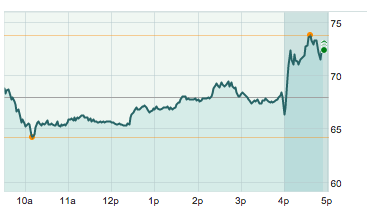
Shares were up over $5 or more than 7 percent in after-hours trading on the Nasdaq, as investors responded favorably to all the good news.

Here’s the chart:

Screen Shot 2014-10-30 at 1.54.13 PM

“The global scale and execution of our HERO4 launch made this the most successful roll out in GoPro’s history,” said GoPro founder and chief executive, Nicholas Woodman., who also touted advancements in the company’s desktop and mobile content management applications aimed at making it easier for GoPro owners to create and share content.

With the earnings, GoPro is sitting fairly pretty as it heads into the holiday season. As part of the bigger muscles the strong public offering afforded the company, Best Buy customers around the country can expect to see more of an in-store presence from the camera maker.

GoPro went public for $24 per share. It closed regular trading at $68.25, and is up past $72 in after-hours trading. Nascent media business or not, investors are happy with what they see. The company is worth around $9 billion.