Pages

June 13, 2015

Oculus Rift Special Event Live Blog

We’ll be at Dogpatch Studios in SF to check out the latest from Oculus, which is most likely going to share some details regarding its upcoming consumer Rift headset launch (set for early 2016). Hopefully we’ll get a lot more specific on release timeline and price, as well as final hardware design. Stay tuned as we reveal all below!

Darrell Etherington June 11, 201511:00 am

Check out some of our coverage here; Oculus Previews “Oculus Touch” Handheld Motion-Tracking Haptic Controllers

Darrell Etherington June 11, 201510:57 am

Darrell Etherington June 11, 201510:57 am

And that appears to be it.

Darrell Etherington June 11, 201510:57 am

Luckey says if you showed this presentation to someone from 10 years ago, they’d think it was sci-fi. Then he’s off the stage.

Darrell Etherington June 11, 201510:56 am
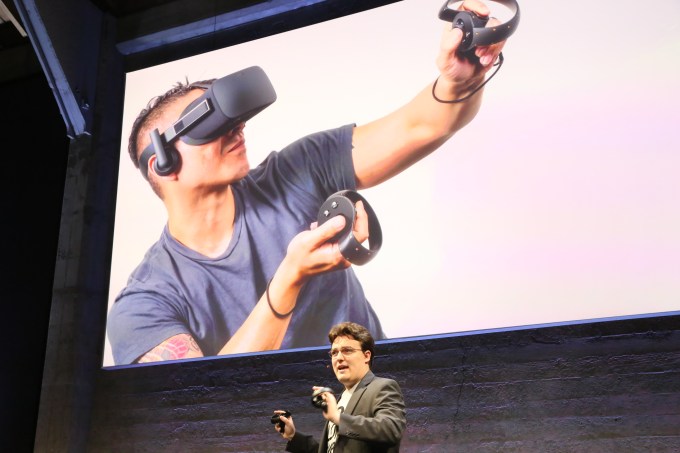
Darrell Etherington June 11, 201510:56 am

Demos will be forthcoming at E3.

Darrell Etherington June 11, 201510:56 am

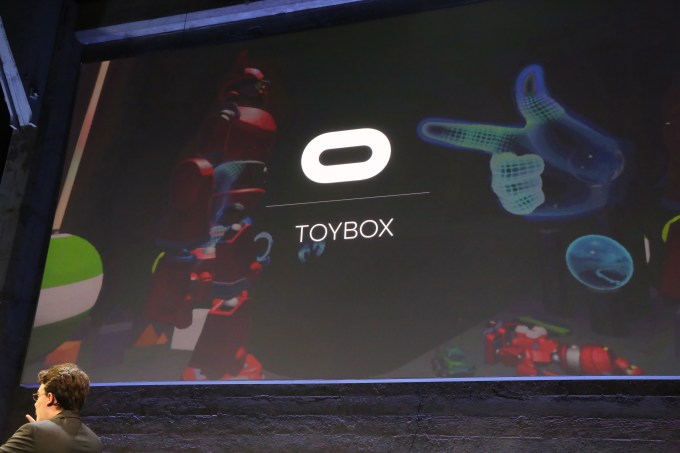
Oculus is using an experience called Toybox to test Oculus Touch input, and Luckey says it works with others to give the impression of multiple people interacting in a shared environment.
Darrell Etherington June 11, 201510:55 am

They also detect touch-based input from all fingers.

Darrell Etherington June 11, 201510:55 am

They have haptics so that you can “feel the objects you’re touching.”

Darrell Etherington June 11, 201510:54 am

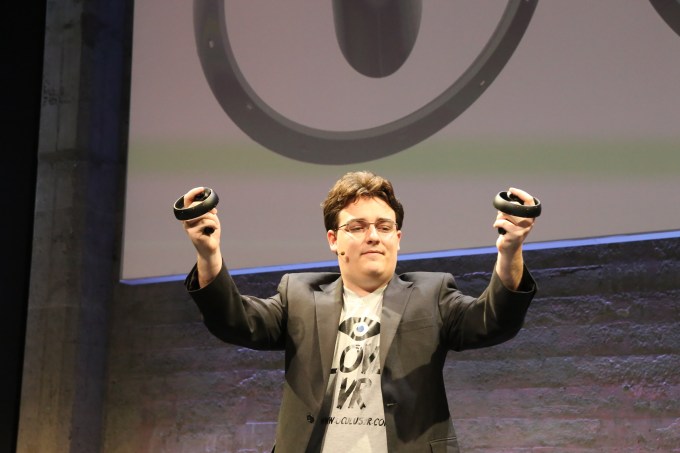
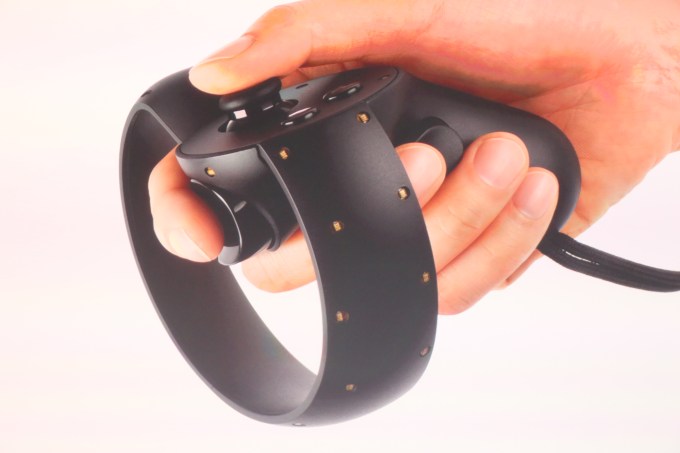
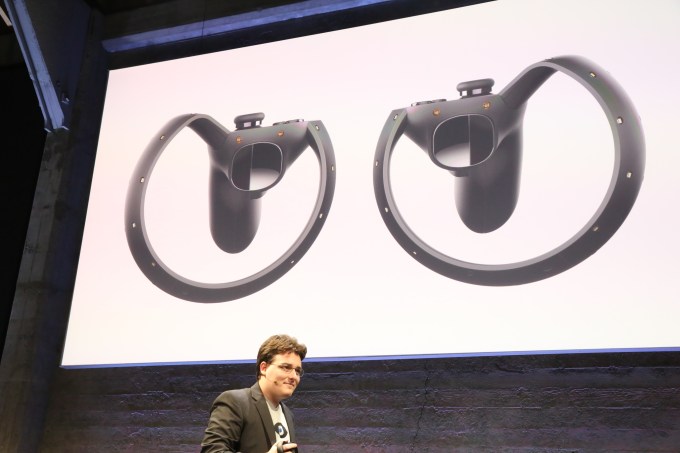
They’re mirror images of each other, they’re wireless, they have 360-degrees of tracking technology and inertial tracking. Each one has a thumbstick, two buttons, an analog trigger, and a hand trigger.

Darrell Etherington June 11, 201510:53 am

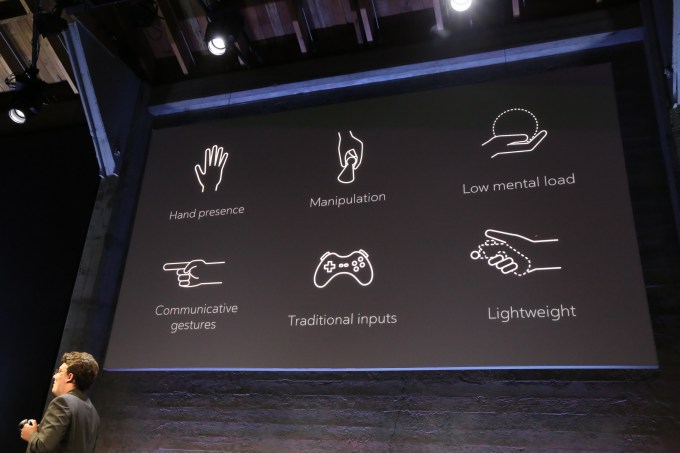
Here’s what Oculus wanted to achieve with this controller design. It was important that it not abandon traditional input, and that it be lightweight.

Darrell Etherington June 11, 201510:53 am
Darrell Etherington June 11, 201510:52 am

Example is that you need to be able to pick up a gun in the virtual world, use it and then discard it seamlessly 

Darrell Etherington June 11, 201510:52 am

Darrell Etherington June 11, 201510:52 am

Goals were to get hand presence, precise manipulation in VR space.

Darrell Etherington June 11, 201510:51 am

This is a dev prototype called “Half Moon.”
Darrell Etherington June 11, 201510:51 am
Darrell Etherington June 11, 201510:51 am
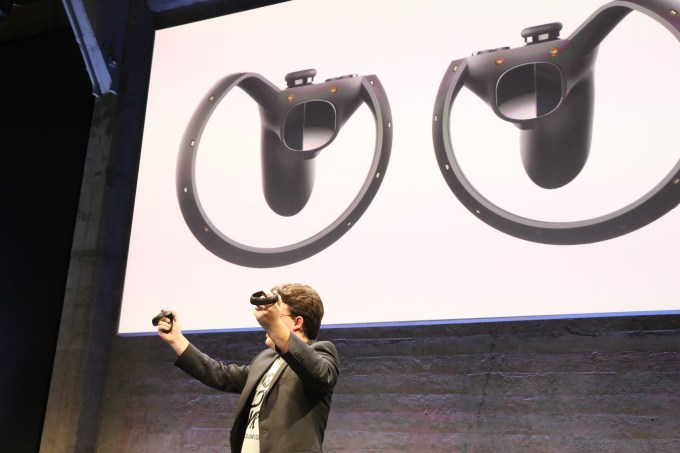
Oculus Touch is the input system!

Darrell Etherington June 11, 201510:50 am

Luckey says one of the first things people do when they try it is reach out into the virtual world.

Darrell Etherington June 11, 201510:50 am

Darrell Etherington June 11, 201510:50 am
Darrell Etherington June 11, 201510:50 am

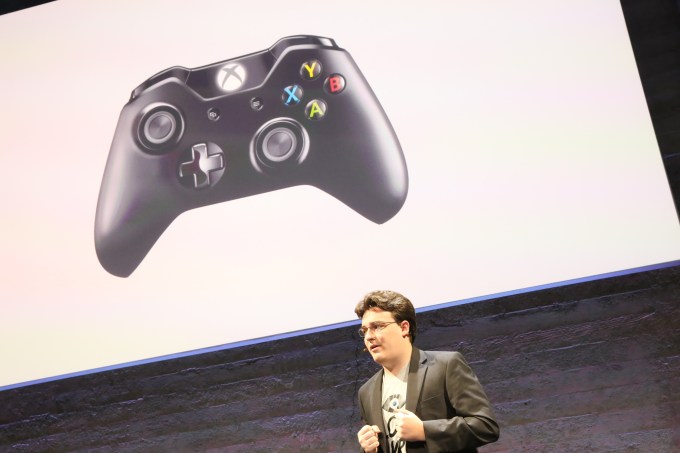
Xbox One controller gives people a common factor to design for, though, Luckey says.

Darrell Etherington June 11, 201510:49 am

“There will be different input for different types of games,” but Oculus is going to show us something of its own today.

Darrell Etherington June 11, 201510:49 am

Darrell Etherington June 11, 201510:48 am

Darrell Etherington June 11, 201510:48 am

Input! Presented by Palmer Luckey

Darrell Etherington June 11, 201510:48 am

“One more thing that we really want to show you.”

Darrell Etherington June 11, 201510:48 am

At E3 you can try everything they’ve shown today.

Darrell Etherington June 11, 201510:47 am

Still that Q1 2016 date, really wish they would go more specific.

Darrell Etherington June 11, 201510:47 am

Iribe is back to recap.

Darrell Etherington June 11, 201510:47 am
Darrell Etherington June 11, 201510:47 am

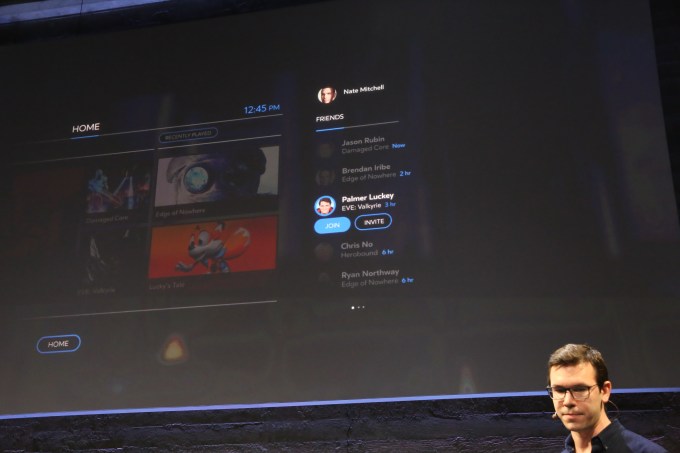
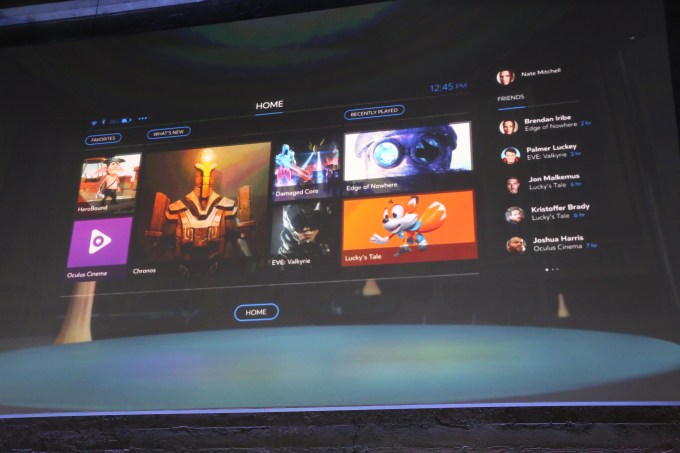
Friends list will let you see what others are up to and jump right in. There’s also a 2D version of Oculus Home for use on your standard computer displays.

Darrell Etherington June 11, 201510:46 am
Darrell Etherington June 11, 201510:46 am
Darrell Etherington June 11, 201510:46 am

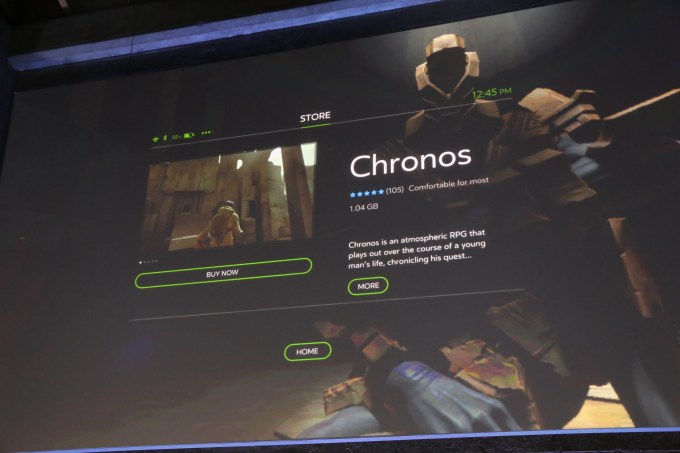
Will feature VR previews of games you can jump right into before you buy.

Darrell Etherington June 11, 201510:45 am

“Jumping off point for everything in the Rift universe.” When you put on the Rift, it’ll drop you right into Oculus Home, including a games list, friends list and more.

Darrell Etherington June 11, 201510:45 am
Darrell Etherington June 11, 201510:45 am

Oculus Home: This is the new system software for Oculus Rift.

Darrell Etherington June 11, 201510:45 am

Says it was a priority to make it “just work” right out of the box.

Darrell Etherington June 11, 201510:44 am

Darrell Etherington June 11, 201510:44 am

Now VP of Product Nate Mitchell is here to talk about Rift software user experience.

Darrell Etherington June 11, 201510:44 am
Darrell Etherington June 11, 201510:44 am

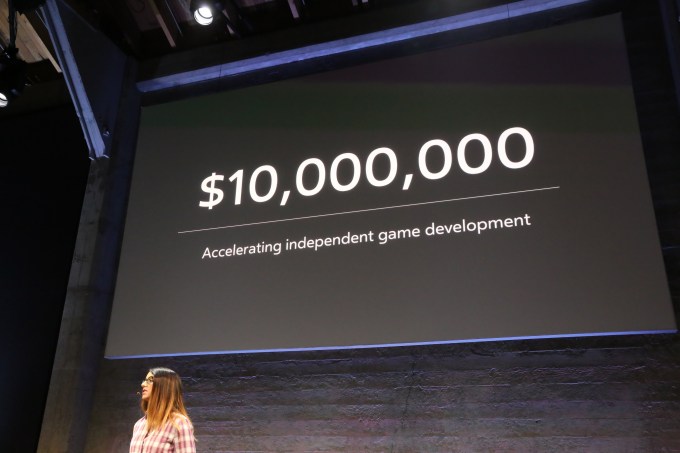
Oculus is announcing more than $10 million to support indie game development for Rift.

Darrell Etherington June 11, 201510:43 am

Improvements are coming to Oculus Share to make it even easier, especially for indie devs.
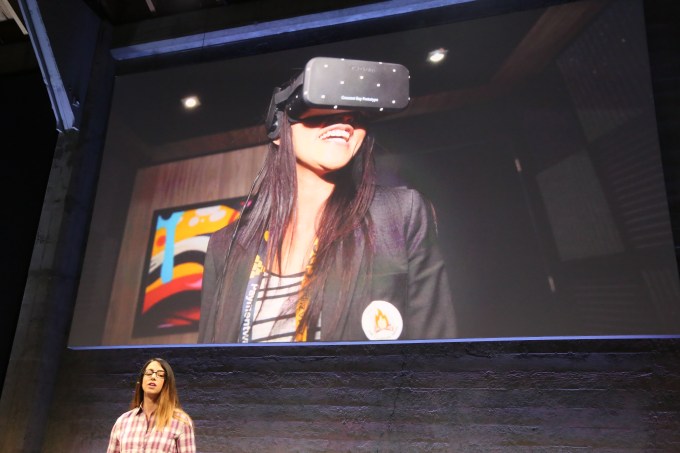
Darrell Etherington June 11, 201510:43 am

Targeting platforms is easy, but that’s not enough. That’s why they created Oculus Share for devs to try others’ creations.

Darrell Etherington June 11, 201510:42 am
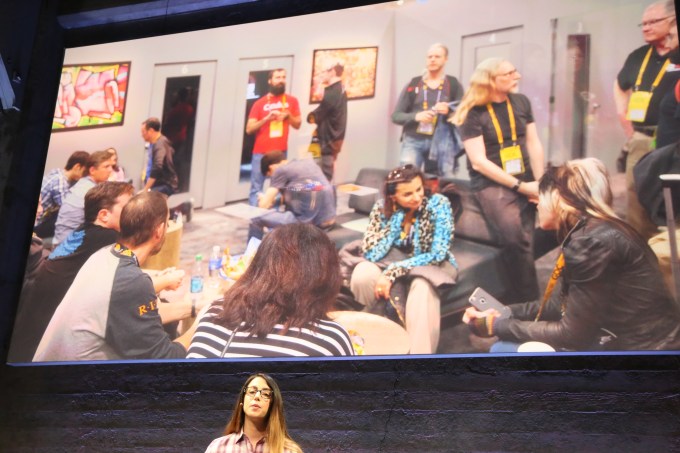
Darrell Etherington June 11, 201510:42 am

Now she says with Rift, anyone can create those kinds of experiences. Thanks to close connection with Unity 5 and Unreal Engine 4.

Darrell Etherington June 11, 201510:42 am

Talking about how Ultima Online addiction meant her parents had to get a second phone line for constant dial-up connection.

Darrell Etherington June 11, 201510:41 am
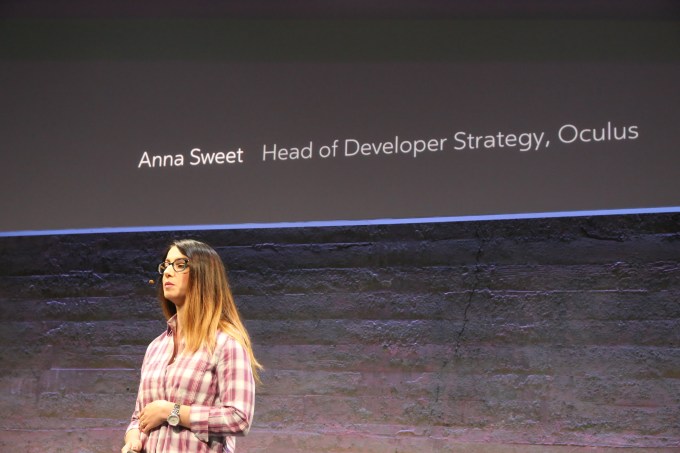
Darrell Etherington June 11, 201510:41 am

They still just keep showing that Q1 2016 date. Now Anna Sweet, head of developer strategy is up.

Darrell Etherington June 11, 201510:40 am

Now we’re watching a composite trailer of the games we just saw, as well as many more. One from within the goalie mask appeals to my Canadian sensibilities.

Darrell Etherington June 11, 201510:40 am

And here’s a look at the developers Oculus is working with.
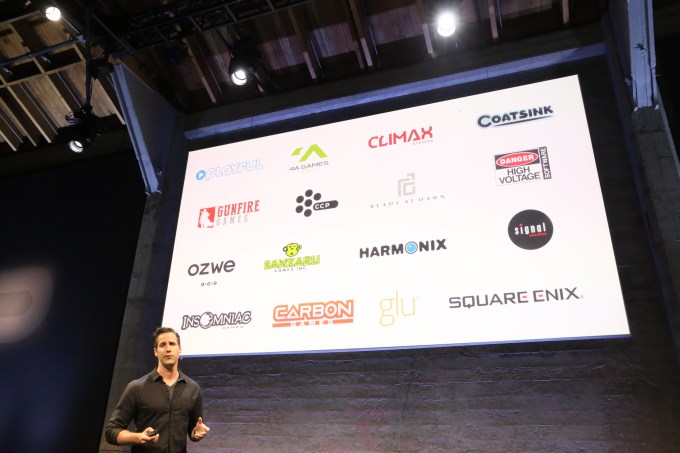
Darrell Etherington June 11, 201510:39 am

Here’s that list.

Darrell Etherington June 11, 201510:39 am

More games coming at E3, Rubin says as he returns.

Darrell Etherington June 11, 201510:38 am

Insomniac founder says he was initially skeptical of VR, until he tried it himself.

Darrell Etherington June 11, 201510:38 am

Scary snow planet adventure, it looks like. I’m a little terrified already.

Darrell Etherington June 11, 201510:37 am

Darrell Etherington June 11, 201510:37 am

Now it’s Insomniac games, revealing their new title Edge of Nowhere, which is an adventure thriller.

Darrell Etherington June 11, 201510:36 am

Darrell Etherington June 11, 201510:36 am

Sounds super cool actually. And different from the usual VR hack/slash/shoot fare.

Darrell Etherington June 11, 201510:36 am

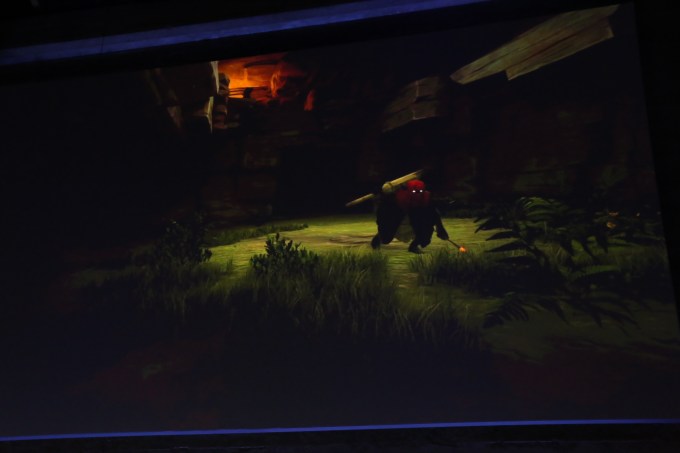
Atmospheric RPG, Adams says. You tackle a labyrinth, which only opens once a year. The twist is that you come back every year, and your player character ages, leading to different abilities as you get older.

Darrell Etherington June 11, 201510:35 am

Darrell Etherington June 11, 201510:35 am

Kinda reminds me of Ico or Shadow of the Colossus.

Darrell Etherington June 11, 201510:34 am
Darrell Etherington June 11, 201510:34 am

Now a new game, called Chronos.

Darrell Etherington June 11, 201510:34 am

Adams says they were super excited about VR and Oculus, worked with them on Herobound 1 and 2.

Darrell Etherington June 11, 201510:33 am

Trailer done, now it’s David Adams from Gunfire Games.

Darrell Etherington June 11, 201510:33 am

Darrell Etherington June 11, 201510:33 am

This trailer is even more amazing on a huge screen, can’t wait to actually experience it in the Rift itself.

Darrell Etherington June 11, 201510:31 am

Darrell Etherington June 11, 201510:30 am

In case you want to see what we’re seeing, here’s that trailer: http://techcrunch.com/2015/03/19/watch-this-eve-valkyrie-trailer-to-get-a-taste-of-what-space-combat-is-like-in-vr/

Darrell Etherington June 11, 201510:30 am
Darrell Etherington June 11, 201510:30 am

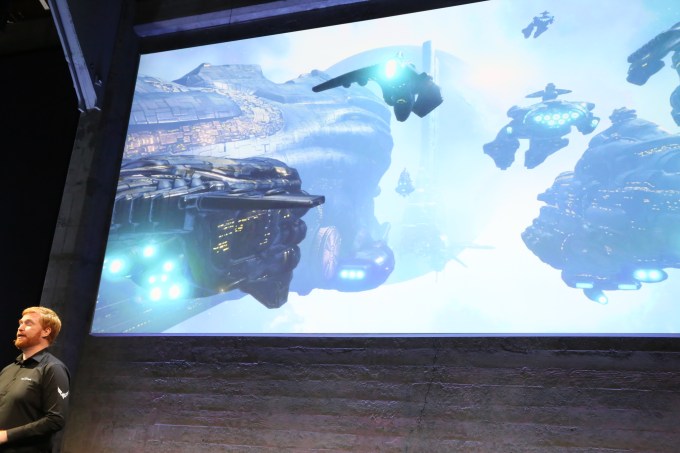
People will be able to try it at E3 next week, and it’s launching next year. Now there’s a gameplay trailer.

Darrell Etherington June 11, 201510:30 am

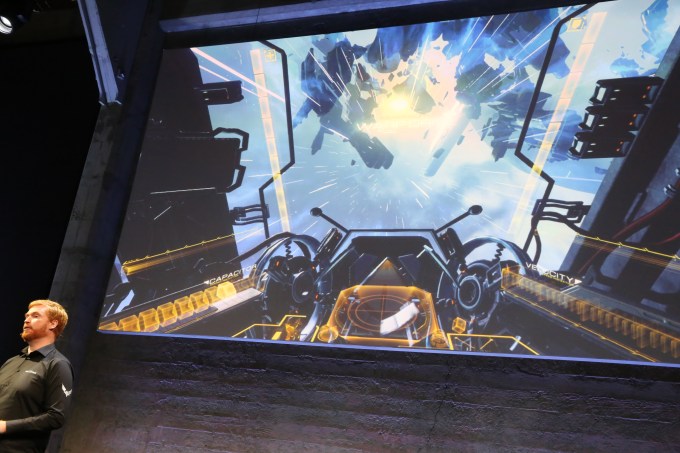
Valkryie is designed from the ground up for VR. You jump in, and you’re immersed in a 360-degree cockpit.

Darrell Etherington June 11, 201510:29 am
Darrell Etherington June 11, 201510:29 am

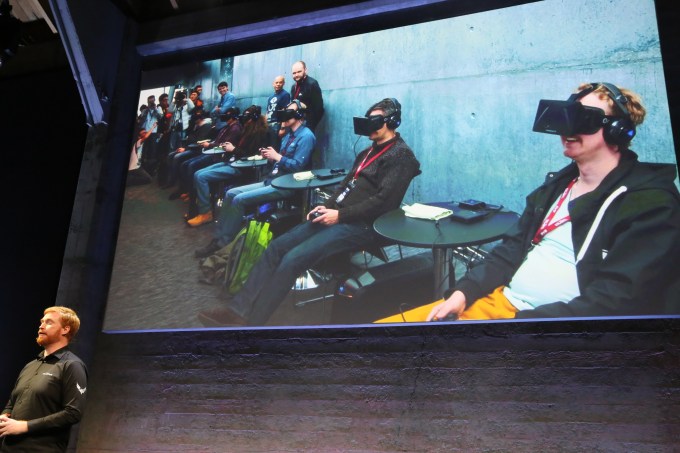
After demoing early versions of Valkyrie to fans, they found the response amazingly positive. Please make this, fans said.

Darrell Etherington June 11, 201510:29 am
Darrell Etherington June 11, 201510:28 am
Darrell Etherington June 11, 201510:28 am

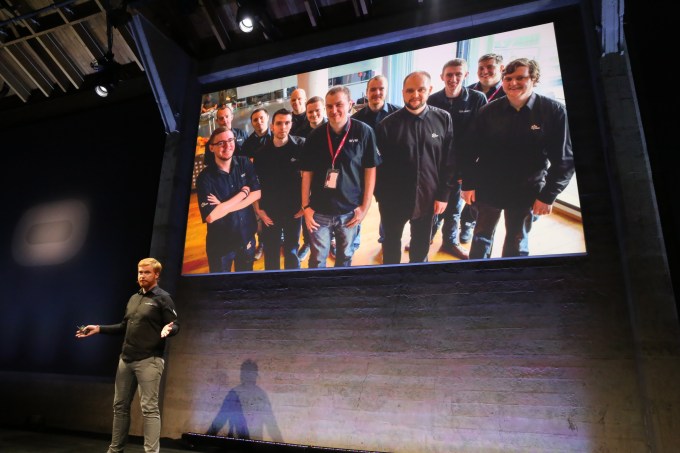
A small team at EVE got DK1 kits, and immediately started building a space combat simulator, having grown up on stuff like TIE Fighter.

Darrell Etherington June 11, 201510:28 am

Now we’re talking about EVE Valkyrie, which is the first-person space shooter designed for VR and Oculus Rift.

Darrell Etherington June 11, 201510:27 am

Here’s the motto of CCP, which VR helps immensely with.

Darrell Etherington June 11, 201510:27 am

Darrell Etherington June 11, 201510:27 am

Hilmar Veigar Pétursson up, he’s the CEO of CCP, which created EVE Online, the massive space sim.

Darrell Etherington June 11, 201510:26 am
Darrell Etherington June 11, 201510:26 am

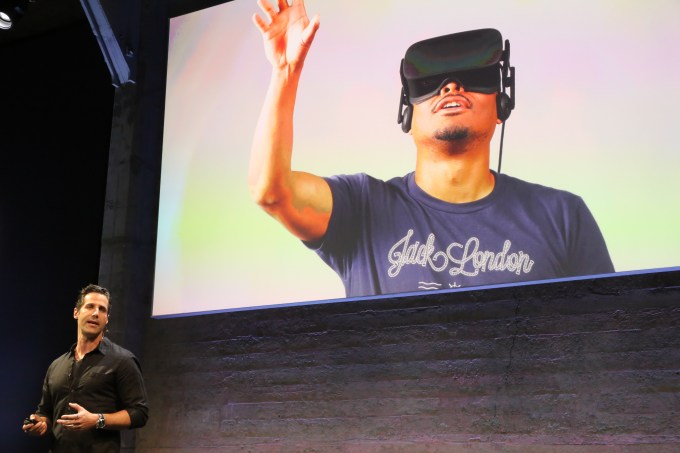
Regardless of advances, we’ve always had a “windows [we] couldn’t step through”. VR changes that, Rubin says.

Darrell Etherington June 11, 201510:25 am

He’s talking about content at launch. Starts with how Star Wars inspired him to want to create worlds.

Darrell Etherington June 11, 201510:25 am
Darrell Etherington June 11, 201510:25 am

Jason Rubin, head of Oculus studios now up.

Darrell Etherington June 11, 201510:24 am

More input news coming later, Iribe says.

Darrell Etherington June 11, 201510:24 am

He suggests that in the future you’ll be able to co-play in a virtual environment with friends.

Darrell Etherington June 11, 201510:23 am

Brendan is back up.

Darrell Etherington June 11, 201510:23 am

Darrell Etherington June 11, 201510:23 am
Darrell Etherington June 11, 201510:22 am

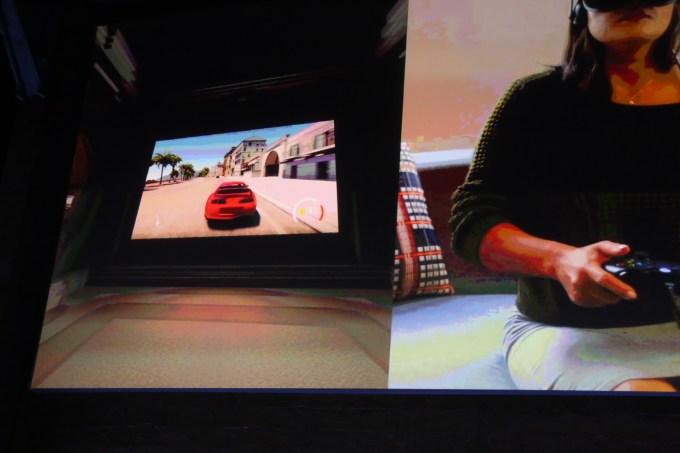
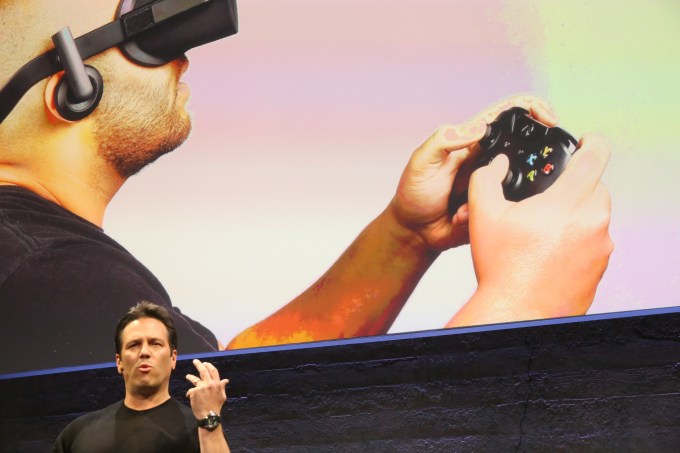
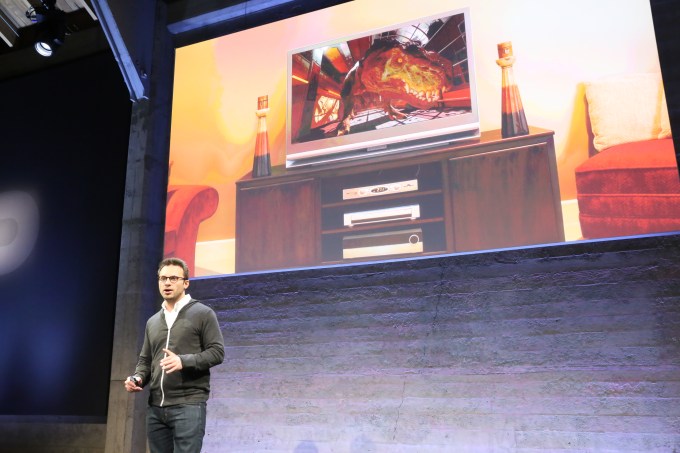
Creates a virtual living room within the VR experience in which to game.

Darrell Etherington June 11, 201510:22 am
Darrell Etherington June 11, 201510:22 am

Streaming Xbox One games to PCs will also be available for Oculus Rift.

Darrell Etherington June 11, 201510:21 am

Windows 10 has native Oculus Rift support.

Darrell Etherington June 11, 201510:21 am

Darrell Etherington June 11, 201510:20 am

This is now a brief Windows 10 ad intermission. Phil is talking about how great the new OS is.

Darrell Etherington June 11, 201510:20 am

Darrell Etherington June 11, 201510:20 am

Phil Spencer, head of Xbox is here to talk about their partnership.

Darrell Etherington June 11, 201510:20 am
Darrell Etherington June 11, 201510:19 am

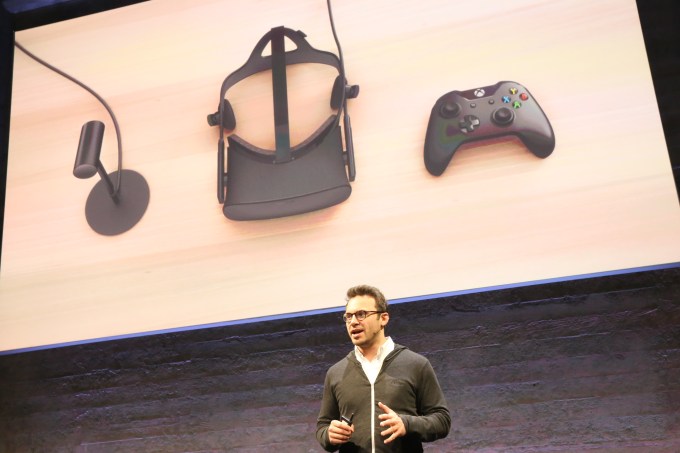
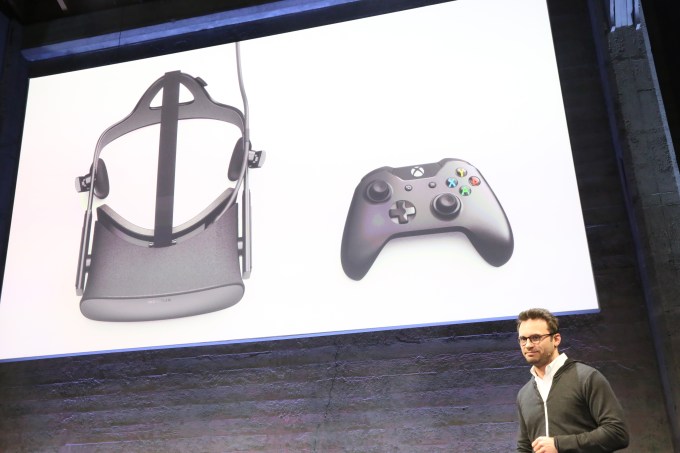
They decided that including a gamepad with this generation of device was crucial. So they’re shipping it with an Xbox One controller and a wireless PC adapter.

Darrell Etherington June 11, 201510:18 am

This has been a huge question mark around Oculus Rift.

Darrell Etherington June 11, 201510:18 am

Next up, we’re talking about input.

Darrell Etherington June 11, 201510:18 am
Darrell Etherington June 11, 201510:18 am

Headset is wrapped in fabric to make it more comfortable to hold with your hands.

Darrell Etherington June 11, 201510:18 am

Darrell Etherington June 11, 201510:17 am

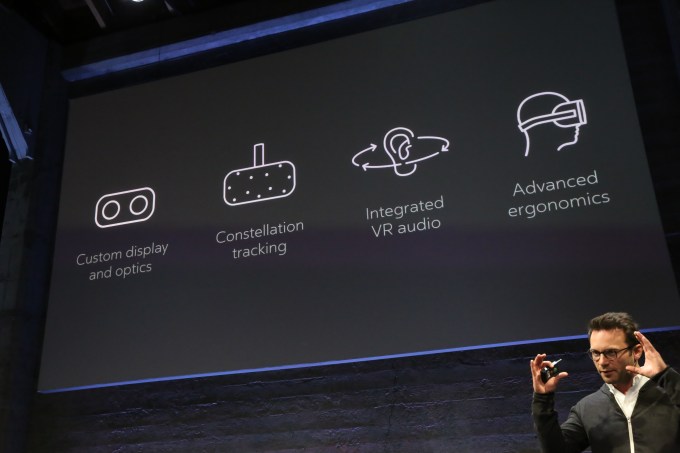
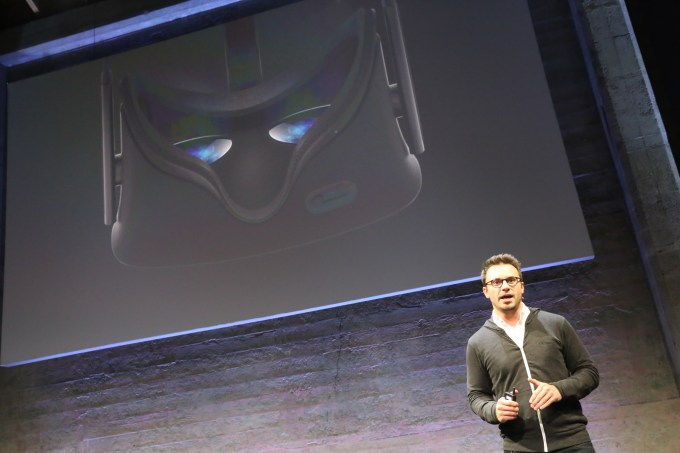
Adjustable slider lets you set the specific distance between your eyes. This is like pupillary distance if you use glasses for vision.

Darrell Etherington June 11, 201510:16 am

Darrell Etherington June 11, 201510:16 am

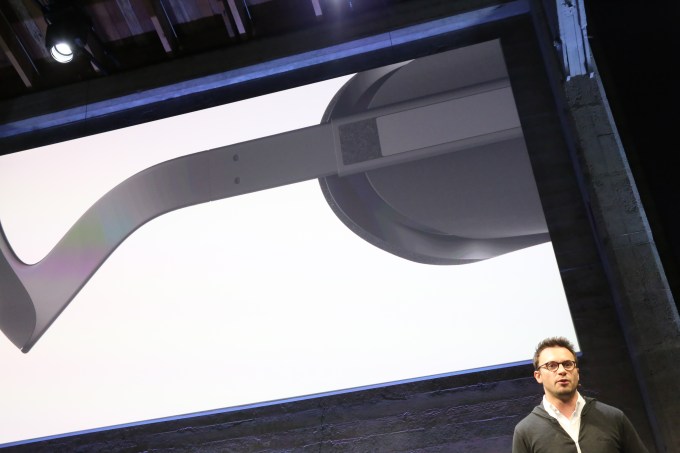
Iribe now detailing the comfort of the headset. Says it’s very thin and easy to wear. Feels lightweight so you don’t feel like you have a huge thing hanging off your face.

Darrell Etherington June 11, 201510:15 am

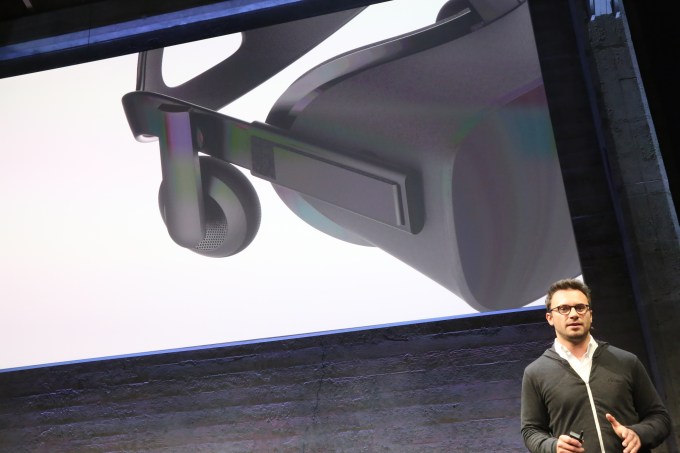
Headphones are removable so you can bring your own.

Darrell Etherington June 11, 201510:15 am
Darrell Etherington June 11, 201510:15 am

“All that audio must be 360,” Iribe says, in order to achieve the desired affect.

Darrell Etherington June 11, 201510:15 am

Rift features an integrated audio system for immersive sound.
Darrell Etherington June 11, 201510:14 am

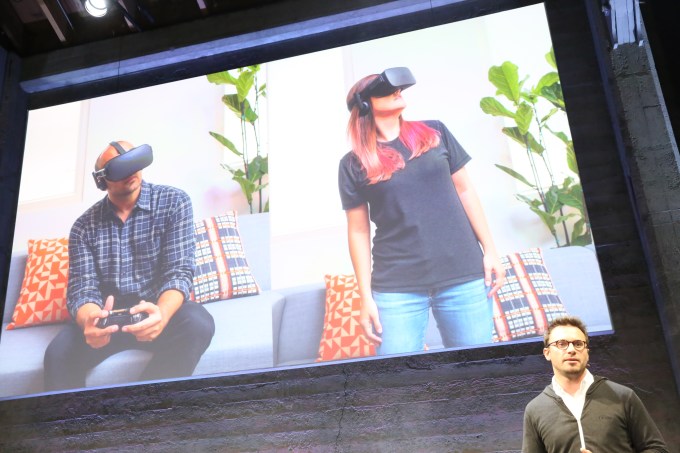
Some seated and some standing experiences, you can use it both ways.
 
Darrell Etherington June 11, 201510:14 am

Darrell Etherington June 11, 201510:14 am

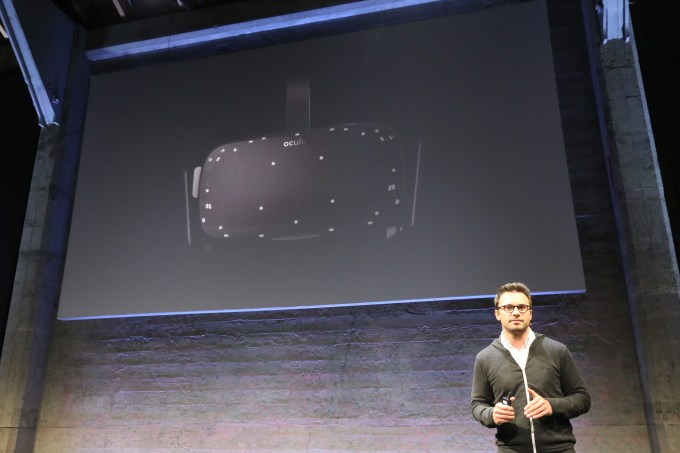
Constellation tracking system determines your position in space. There’s also a new sensor for desktop use to work with the constellation for tracking.

Darrell Etherington June 11, 201510:13 am
Darrell Etherington June 11, 201510:13 am

Hardware has a wild field of view, and a new constellation tracking system.

Darrell Etherington June 11, 201510:13 am
Darrell Etherington June 11, 201510:12 am

Now Iribe is talking about how they got VR to the point where your brain has to convince itself this isn’t real.

Darrell Etherington June 11, 201510:11 am

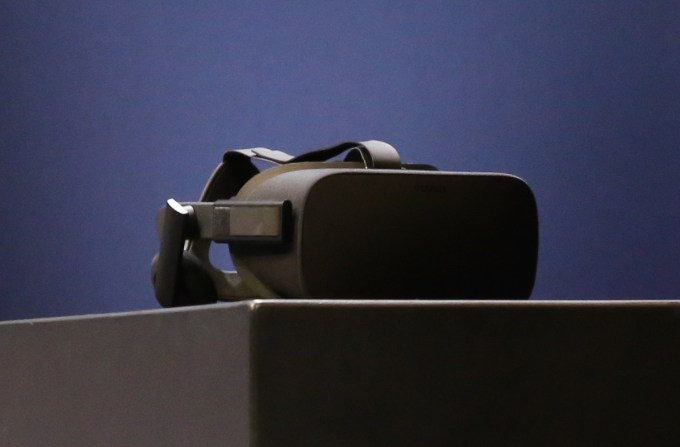
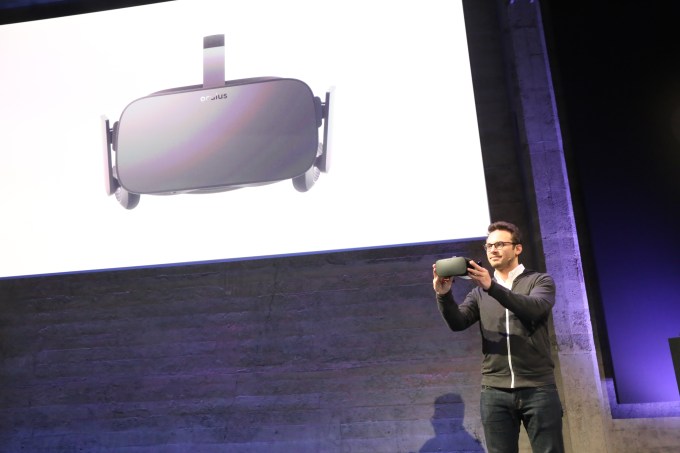
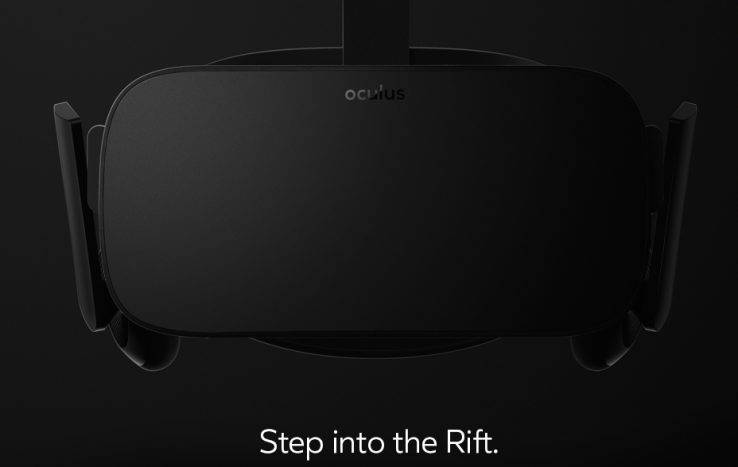
This is the first time we’ve seen a physical version of the shipping hardware.
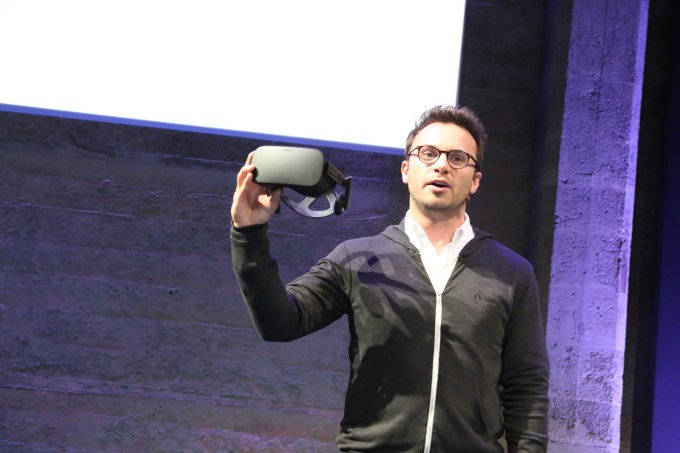
Darrell Etherington June 11, 201510:11 am

Darrell Etherington June 11, 201510:10 am

And we’re doing the rift hardware and OS reveal.

Darrell Etherington June 11, 201510:10 am

Darrell Etherington June 11, 201510:09 am

“This is gonna change everything. We’ve all been dreaming about this for decades.” 

Darrell Etherington June 11, 201510:09 am

Oculus can make the T-Rex real, that’s the whole point.

Darrell Etherington June 11, 201510:09 am
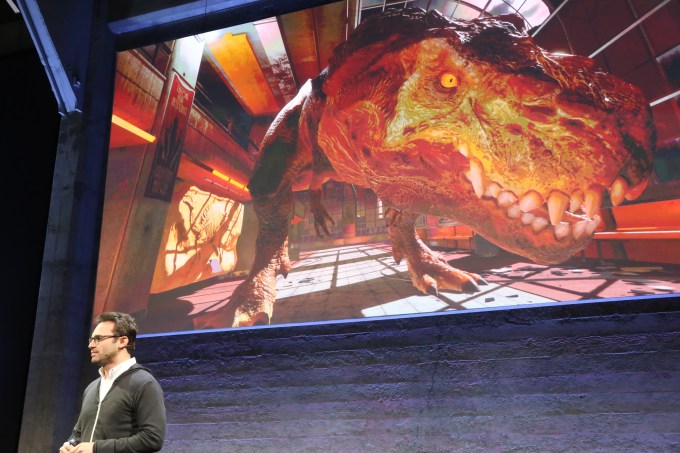
Darrell Etherington June 11, 201510:09 am

Using a T-Rex as a demonstrative example. T-Rex being here would scare the pants off all of us basically.

Darrell Etherington June 11, 201510:08 am

No matter what the advances in video games, we’ve still always been trapped with a 2D screen, Iribe says. No matter what you can achieve with a screen, you can’t achieve the feeling of being there.

Darrell Etherington June 11, 201510:07 am

Darrell Etherington June 11, 201510:07 am

Now answering the question of “Why VR?” Basically because we’ve always been moving towards it, from the beginning of gaming.

Darrell Etherington June 11, 201510:07 am
Darrell Etherington June 11, 201510:06 am

Giving props to supporters of the project now.

Darrell Etherington June 11, 201510:06 am

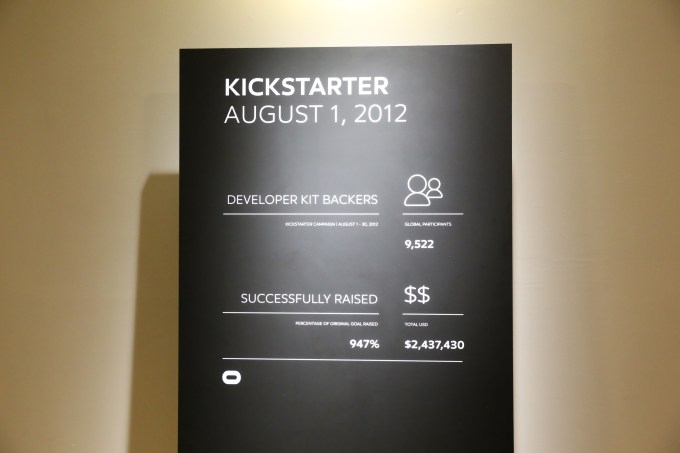
He’s giving us a history of Oculus. Three years ago they launched the Kickstarter.

Darrell Etherington June 11, 201510:06 am

Brendan Iribe is up. 
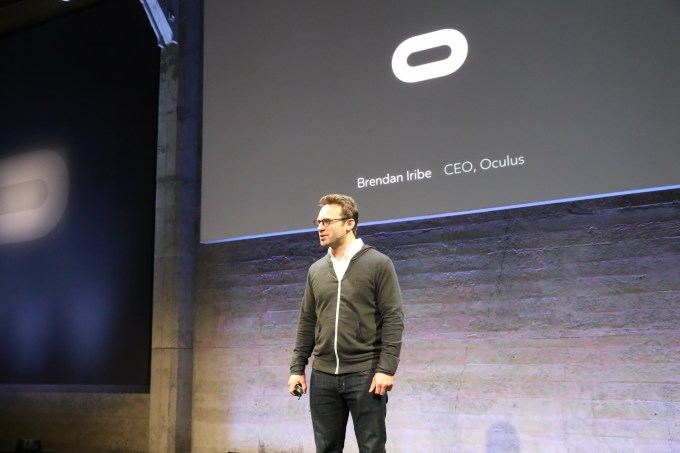
Darrell Etherington June 11, 201510:05 am

Here’s Josh Constine in full-on blogger mode. https://tctechcrunch2011.files.wordpress.com/2015/06/oculus-rift-pre-e30005.jpg?w=680

Darrell Etherington June 11, 201510:04 am

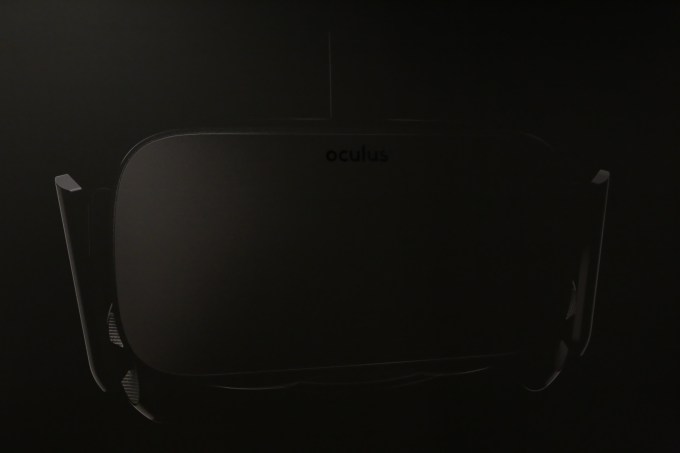
This is the new logo, as seen dimly through a gauzy light filter of some kind. Ethereal.

Darrell Etherington June 11, 201510:01 am

Here’s the crowd. Lots of familiar tech press faces.

Darrell Etherington June 11, 201510:00 am

I would love to Oculus.

Darrell Etherington June 11, 20159:59 am

We’re in!

Darrell Etherington June 11, 20159:14 am

Stats!

Darrell Etherington June 11, 20159:08 am

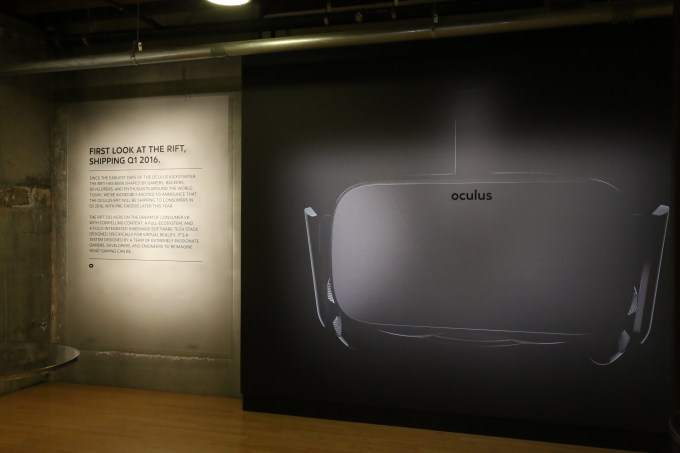
Here’s the more readable version of that paragraph describing what we’re here to see.

Darrell Etherington June 11, 20159:07 am

Behold the monolithic Rift headset image that dominates this waiting area.
Darrell Etherington June 11, 20159:00 am

Here’s that fancy new Oculus logo, in all its shiny glory on a super hip concrete wall.

Darrell Etherington June 11, 20158:57 am
Darrell Etherington June 11, 20158:57 am

Darrell Etherington June 11, 20158:57 am

We’re in and waiting for the event to start. There’s a lovely press area here for us to wait in, complete with stats on Oculus hardware to date and a teaser of what’s on tap for today.

post from sitemap

Apple’s iPad Multitasking Powers Hint At iPad Pro And Beyond

Apple is encouraging developers to stop thinking about their user interfaces in terms of specific devices and orientation, and to start thinking in terms of different view types, in the interest of building interfaces that work with the multitasking mode introduced for using apps side-by-side on iPad in iOS 9.

The changes reflect the best example of Apple’s tendency to ‘telegraph’ future product announcements with changes to development tools and frameworks, however, laying the groundwork for the much-discussed larger iPad Pro supposedly coming later this year – and other devices not yet announced.

Previous versions of Apple’s developer tools encouraged those building apps to think in terms of interface orientation, with portrait and landscape acting as the primary situators. The new way of thinking favours ‘compact’ and ‘regular’ width views, with compact being what we’d traditionally associate with an iPhone portrait look, for instance, and regular looking like larger Apple devices, including the iPhone 6 Plus and iPad, in landscape (often displaying multiple columns at once).

Rather than being tied to devices, however, this new method allows for side-by-side views on iPad, including the one-third slide over mode, where an app has a single column that takes up just a small portion of the iPad’s overall screen, or split view, where it’s taking up a full half of the available real estate. In the new paradigm, it’s not about devices or which way the display is oriented; it’s about how a user has selected to view apps on the same display in multitasking mode.

This is significant because, like Apple’s attempts to encourage developers to get on board with adaptive user interfaces last year in preparation for the then-unannounced iPhone 6 and 6 Plus, this seems to be Apple subtly saying that developers should expect to see more in the way of split displays in future iOS devices.

The iPad Air 2 is currently the only application that supports true split view, multi-app interactivity (others let you peek at secondary apps without interacting with both simultaneously). But it’s clear that future generations of iPad will likely support this across devices, including likely on an updated iPad mini with an improved processor. The rumoured iPad Pro is also a prime candidate for this type of interface, given its likely focus on work and productivity applications.

I’d go even further and suggest that Apple might be thinking long-term about how this could apply broadly to all iOS devices – the 6 Plus already behaves a lot like an iPad when used in landscape mode, for instance, and it’s not hard to envision it supporting a split-screen interface given the flexibility of a single-column vertical scroll mechanism for apps like iMessage or Notes.

Some developers I’ve spoken to say that while the change in thinking seems a little daunting at first, modifying iPad apps to take advantage of the new multi-tasking powers in iOS 9 actually shouldn’t be that difficult. And Apple’s making it clear this time – doing so will reap benefits long-term in terms of addressing unannounced hardware platform that may appear in the future.

post from sitemap

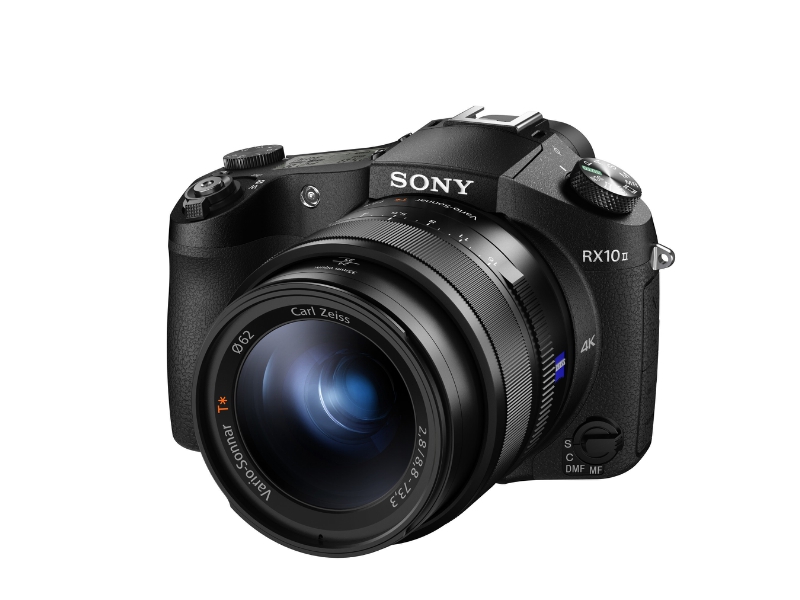
Sony’s Compact RX-100 IV And RX-10 II Cameras Pack A Big Punch

Sony has a couple of new cameras it revealed today, including the RX-100 IV and the RX-10 II. The new compact cameras offer powerful sensors in small packages, continuing Sony’s long tradition of shaking up the consumer and prosumer photography categories. New to the cameras is a special sensor, the “first stacked 1.0 type CMOS sensor with a DRAM chip,” according to Sony, which should translate to very fast performance, and which enable amazing slow-motion video capture, as well as 4K video capture.

The RX100 has long been a technical standout in the consumer camera industry – it was the first pocketable camera to offer a full 1-inch sensor for low-noise, high quality image capture. This fourth-generation RX100 is again pocketable, and boasts a super bright F1.8 to F2.8 aperture lens, with a 24-70mm zoom range when translate to 35mm analog equivalent.

The RX10 II is a little beefier, but no more so than its predecessor, an includes a 24-200 zoo lens for extended reach. Both cameras have fixed lenses, which means you can’t swap out the glass, but they’re designed to be single-serve flexible options for people who don’t want the hassle of a multi-lens system.

The digital finder on the back is now the XGA OLED Tru-Finder variant new from Sony, which offers high contrast and more true-to-life color rendering. They also have a new faster intelligent autofocus system, which Sony says can lock on to a subject in as little as 0.09 seconds. Both also have built-in NFC and Wi-Fi.

Pre-order sales for both start on June 17, with pricing starting at “about” $1,000 for the RX-100 IV, and $1,300 for the RX-10 II. Actual shipping dates haven’t yet been announced by the company.

Sony RX10 II Camera (PRNewsFoto/Sony Electronics)

Sony RX10 II Camera (PRNewsFoto/Sony Electronics)

Sony continues to push the limits when it comes to consumer dedicated cameras, and these look like they could be ideal travel/work cameras for a wide group of users. Those price tags aren’t cheap, but this new sensor tech might offer enough advantages, including 4K recording (though with 29 and 5 minute max recording length for the RX-10 II and RX-100 IV respectively), and super slow mo video that can capture footage at an astounding 960fps, 480fps or 240fps (the current maximum slowdown possible on the iPhone 6, for reference).

Arguably, the dedicated camera market is a dwindling field – but these look like market leaders for the niche that remains.

post from sitemap

In The U.S. Smart Home Market, Don’t Rule Out China

It’s no secret that the smart home is a hot industry generating big-time buzz from VCs and large technology companies alike. The dream of a fully automated and connected home, where control of every device is at its owner’s fingertips, has attracted leading innovators.

Earlier this year, more than 700 companies — from big players such as Samsung to startups like Ecovent, PetCube, and Quirky — descended on the Consumer Electronics Show to display their latest products.

Established companies have positioned themselves in the industry through major deals, such as Google’s $3.2 billion acquisition of Nest and Samsung’s purchase of SmartThings for $200 million. Meanwhile, startups are squarely focused on developing innovative products that push the boundaries of “smart.”

So how will the market unfold in the coming years? And which company will achieve U.S. market dominance. In this quest, at first blush U.S. companies would seem to have an impressive lead. Many observers believe pure innovation is the best indicator of which companies will eventually dominate the smart home market, and each day seems to bring an impressive new product release. Appearances can sometimes be deceiving, particularly if you use the wrong definition of what winning looks like.

The smart home industry won’t be advanced by throwing as many sensors into a device as possible or creating a robot controlled by voice commands. Similarly, the industry isn’t waiting for a breakthrough technological advance to finally achieve its potential. The technologies essential to developing smart home products — Bluetooth and product sensors that make up the Internet of Things — aren’t new; they’ve been around for decades.

To establish market dominance, companies must develop ecosystems or a unified platform of elegant user experiences to enable the convergence of the full range of smart devices.

Asian consumer electronics companies, especially recent Chinese wunderkinds such as Xiaomi have been building a tremendous production advantage based on three key elements: engineering, manufacturing and massive scale.

The smart home industry won’t be advanced by throwing as many sensors into a device as possible or creating a robot controlled by voice commands.

With rapid innovation cycles that produce high-quality, low-priced goods, Chinese companies have the scale and consumer base to set the standard for interoperability — possibly before they even enter the U.S. smart home market. U.S. companies that want to thrive should redouble their efforts in providing products with real utility to the customer while closely monitoring the progress of Chinese companies. Their very survival could depend on it. 

An integrated platform for smart devices

My investment firm, Formation 8, has been tracking the smart home industry’s evolution in both Western markets and Asia. To date, we’ve invested in smart home companies that have emphasized user experience and features that deliver tangible value to customers. Our approach recognizes that smart home products aren’t just about technology; they are about what technology can do for users.

That’s why ecosystems matter: a smart thermostat or appliance may provide some incremental benefit; as part of an integrated platform for smart products, the value is far greater than the sum of its parts. What the smart home industry has been lacking to date is a commonly accepted way to aggregate and access multiple devices in a simple, seamless way.

While companies such as Smart Things and Revolv have attempted to build these platforms right off the bat, their reach is limited because the use cases haven’t addressed major pain points for customers.

For this reason, the convergence of entertainment content is a particularly relevant development. Smart home companies looking for a common platform to engage consumers would be wise to focus on the devices and activities that take up the bulk of consumers’ time and attention. In 2014, the average U.S. adult spent approximately 12 hours a day consuming media, with mobile and television accounting for 47.1 and 36.5 percent, respectively.

In many households, television — whether smart TVs or set-top boxes such as Apple TV and Roku — has become the primary access point for programming, music, apps, Internet browsing and gaming, among other activities. Mobile devices have begun to double as remote controls, but the proliferation of apps that users must download to manage their entertainment and smart home appliances can be a barrier for adoption.

China’s formidable advantages

Products that can consolidate all of these activities would be well placed to accommodate other smart devices in a single platform. This is where China is moving at a furious pace thanks to three key components.

Engineering

Since the smart home industry is more about integration than breakthrough technology innovation, the engineering challenge is how to bring together different devices into a single platform quickly.

Hundreds of thousands of engineers graduate from Chinese universities each year, and this deep pool of talent has enabled Chinese companies to develop new products at an unprecedented rate. For example, Chinese startup Miya developed and manufactured a smart personal weight scale in just six months for less than $3.4 million.

Manufacturing capacity

Although China is eager to move beyond being seen as just a low-cost manufacturer, it still has a tremendous advantage. With an established and superior domestic supply chain of manufacturers, Chinese companies can produce goods at much lower prices earlier in the product life cycle.

For example, Chinese companies barely break a sweat in rapidly producing a high volume of new prototypes. Manufacturing represents a competitive advantage that U.S. companies can’t replicate: local corporations have coveted relationships with state-owned entities and homeland partners that are typically not available to unfamiliar parties.

When partnering with U.S. companies, a Chinese supplier doesn’t have the channel or awareness to partner with an unproven startup from Silicon Valley. Our firm is trying to close that gap, since we believe partnerships can accelerate the life cycle of a business by years.

Scale

Leading Chinese consumer electronics companies have had to pursue scale to serve the local market. In 2014, approximately 37 million LCD TVs were sold in the U.S. market; meanwhile, Hisense sold 47 million TVs alone in Q1 2014. Every 1 of 2 TVs in China is made by Hisense, which is also moving aggressively in the global Ultra HD smart TV market. Chinese companies shipped 100 million smart TVs and set-top boxes from 2012 to 2014.

Beyond sheer production volume, scale confers a critical advantage: much like Walmart with its supplier or California on fuel-efficiency standards, Chinese companies have the potential to establish the platform that smart home companies must use for their devices.

Impressive innovation from Chinese companies

Thanks to the combination of these three elements, Chinese companies have excelled in products that consolidate smart devices. Taking a page from Apple, Chinese consumer electronics companies are creating their own ecosystems, extending beyond hardware and seeking to differentiate themselves on software, as well. Huawei, for example, produces a state-of-the-art platform that enables rich content aggregation and device mirroring.

Chinese companies are now successfully integrating the Internet of Things into their design concepts — Haier, for example, already offers a number of television models that can connect to all their consumer devices, and Skyworth has developed its own operating system for its smart televisions.

Major hardware manufacturers are also forging partnerships with content providers: TCL’s has partnered with iQiYi, China’s largest online video operator, to create a consolidated programming platform. In the future, leading companies will continue to integrate other product types and services into their ecosystems. 

How U.S. companies can remain relevant

These developments have huge implications for U.S. smart home companies. Over the past decade, Chinese companies have ridden the twin waves of an exploding Chinese middle class and the emerging dominance of e-commerce to become major players with the potential to threaten established global companies.

To date, these companies have largely focused on the domestic market due to its sheer size, but even this has enabled them to create vast wealth that can and will be redeployed into new ventures. Chinese companies now have the resources to finance a new era of innovation in the smart home market, and a growing middle class gaining an increasing appetite for the leading technology.

To enter the U.S. market, Chinese companies are quietly considering acquisitions, much as Lenovo did with IBM’s PC business. They have incredibly deep pockets to finance this strategy: Alibaba sells to hundreds of millions of Chinese consumers and has a market cap of more than $200 billion, placing it among the top five companies in the world by this measure.

Xiaomi released its first smartphone in 2011 and is now the third-largest smartphone maker in the world. Hisense has a market cap of $34 billion. With such resources, I anticipate that a Chinese company will buy a Fortune 500 company in the next ten years.

Large U.S. companies and start-ups alike must address this threat to remain viable. Google, for example, owns the platform, has ample resources, and is trying to integrate its suite of smart home products (Dropcam, Nest, and Revolt). The company lacks expertise in many critical elements of the hardware development cycle such as user engagement, however—a condition it continues to try to remedy through acquisition.

Although startups may be at the forefront of innovation, manufacturing times and production cost remain important barriers, albeit decreasing in Silicon Valley due to open source, contract manufacturing, and partnerships.

Unfortunately, over the past 10 years, the focus of Silicon Valley venture firms on software vs. hardware has not created an equivalent environment for hardware companies. Formation 8 sees a tremendous opportunity here, and we will be announcing several new initiatives to address the needs of entrepreneurs brave enough to work in hardware.

To survive in a swiftly evolving market amidst increasing competition, U.S. companies should focus on the strengths that brought them to dominance in the first place:

  • Stay true to the user experience. U.S. companies’ innate knowledge of U.S. consumers is a key differentiator in pursuing user satisfaction and adoption. They must continue to pursue excellent product designs that deliver exceptional user experience. While they may no longer be first, or fastest, they must be right. 
  • Push software and services to create ecosystems. U.S. companies should strive to create products with components that extend beyond the hardware to include software, intellectual property, user communities, and services that can’t be copied by Chinese competitors. An ecosystem model that encompasses multiple products seamlessly functioning together can help secure and maintain a competitive advantage. 
  • Join ‘em. Instead of viewing Chinese companies as adversaries in the race to innovation, U.S. smart home businesses should consider forging strategic partnerships. The old paradigm of attempting to establish a market position through innovation alone is dead, thanks to the accelerated new-product life cycle. In its place, U.S. companies can partner with Chinese businesses to gain the manufacturing muscle and scalability they lack in return for sharing their ideas and technology. And if they play their cards right, they could be positioned to enter the Chinese market through a joint venture.

The smart home market is still very murky and very much up for grabs, and the U.S. and Asian markets illustrate different paths to innovation. As in other industries, the U.S. smart home market may soon see low-cost attackers significantly alter the equation.

The question is whether U.S. companies will be able to carve out a position built on innovation that can withstand this disruption. When developing business strategy, U.S. executives should look beyond their borders and weave in lessons from Chinese players that have been able to execute successfully over the past decade.

Featured Image: BartlomiejMagierowski/Shutterstock
post from sitemap

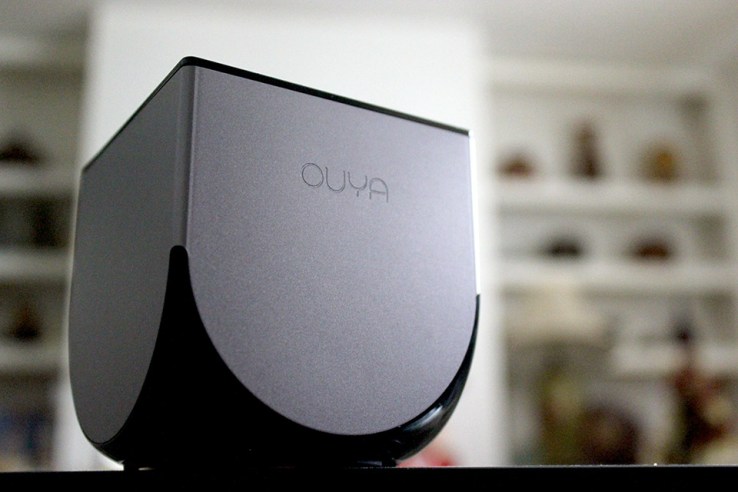
Android Game Console Maker Ouya In Talks To Be Acquired By Razer

We’re hearing that Razer, which creates laptops and other gaming hardware, is in the process of acquiring Kickstarter-backed Android console maker Ouya. TechCrunch couldn’t learn the terms of the deal, which we’ve heard are still in flux, but the acquisition would bring to a close the tale of a very early first-mover in the market of set-top gaming consoles outside of traditional power players.

Ouya was one of the most successful Kickstarter projects of all time, raising around $8.6 million before getting a $15 million round from investors like Kleiner Perkins and Mayfield Fund. The project originally sought to raise around $1 million but promptly blew past that goal in its first day on Kickstarter.

One of the first of its kind android consoles, Ouya offered developers a way to build games that were specifically tuned for a television experience. This was at a time when Microsoft and Sony had an independent developer ecosystem, but nowhere near as fleshed out as it is today (and at the time, the developer kits actually had a price tag). Throughout the past several months, Ouya has held conversations with around a dozen or so companies about a potential fit — though it could have been more than that — according to our sources.

That challenge, too, was apparent to co-founder Julie Uhrman, who told NPR in an interview that “it takes a lot of guts and courage. If I wasn’t a female, I’d say, ‘big balls.’ ”

Uhrman is a longtime video game exec with more than a decade of experience, and with the initial success of the Kickstarter campaign Ouya quickly attracted interest from independent developers. The more open hardware, too, piqued their curiosity. Last year around this time the company had 36,000 registered developers. It enlisted the likes of Kellee Santiago, one of the original creators of Flower, to help build out its developer ecosystem.

Earlier this year, Alibaba invested $10 million in Ouya with plans to actually find a way into the console market in China, which even today is nascent. We heard that deal valued Ouya somewhere between $60 million and $80 million. Alibaba has its own set top Android devices, and at the time expressed interest in bringing the company’s games to those devices, according to a report by The Wall Street Journal. At that point, it became increasingly clear that Ouya was valuable as much as a game development platform as it was a hardware manufacturer.

But of course, being the first of its kind comes with an array of challenges that even at the time are hard to foresee. But despite building a large independent developer ecosystem, the company still faced the challenge of facing broad adoption in an increasingly competitive Android set top market that quickly saw new challengers like Amazon and even Google. Ouya, also like some startups, faced the challenge of dealing with venture debt after securing some from TriplePoint Capital, according to a report by Fortune.

And hardware in general is a tough business to be in. The console was originally designed by Yves Behar, and during the fundraising process Ouya had considered an updated version of the console, our sources said around the time of the reports of a potential strategic investment. Building hardware and a strong supply chain can be a major and expensive challenge for new startups that may have to deal with delays and an extensive negotiating process.

Still, the excitement around the Kickstarter campaign and its early venture round proved that there was a market for set top Android devices, and even larger companies began building new products for that market. But the first mover is not always the mover that wins.

Uhrman did not respond to a request for comment.

post from sitemap

Oculus App Store Will Require Pre-Approvals, Comfort Ratings, Tax

Oculus doesn’t want to make you puke or scare you to death. So when its revamped app store launches for its consumer Rift headset shipping Q1 2016, it will review games and experiences for safety, CEO Brendan Iribe tells me.

Yesterday Oculus held a press event where it unveiled the consumer Rift headset that will come with an Xbox controller and optical sensor, showed off some upcoming flagship games, and previewed its Oculus Touch handheld motion controllers.

Here’s a gallery of all the gadgets Oculus revealed:

After the presentation, I caught up with Oculus’ CEO to ask how his company will work with third-party hardware and software developers.

Motion Tracking For All

The new Oculus Rift sensor camera can track the movement of a constellation of LEDs on the Rift headset, and soon, third-party hardware

The new Oculus Rift sensor camera can track the movement of a constellation of LEDs on the Rift headset, and soon, third-party hardware

Oculus is making its own hardware but will be compatible with a wide range of outside peripherals. An Oculus SDK will let third-party devices pass data to the headset, but they’ll also be able to piggyback on Rift’s sensor.

The way Rift tracks your head movement is by covering the headset with a constellation of little LED markers that the sensor camera can recognize. The company put them on its new Oculus Touch motion controllers too. But Iribe tells me outside developers will be able to coat their devices in the markers, which will let the Oculus sensor track them as well.

Screen Shot 2015-06-12 at 1.12.59 PM

The white dots inside the Rift are LEDs tracked by the Oculus sensor to translate physical movement into VR

Iribe says Oculus is still in the planning stages talking to developers, but tells me “it’s going to be really easy for other people to make third-party controllers that work with that same tracking system. We’ll be providing full APIs for the entire tracking system, the headset system, and the audio system.”

You can check out the new Rift headset, tracking sensor, and Oculus Touch controller up close in this video:

Pre-Approvals, Just Like Apple’s App Store

As for software, Oculus announced it’s working with huge game studios like EVE’s CCP Games, Gunfire Games, and Insomniac Games, and will invest $10 million into indie game developers. But what’s the process to get games and other experiences to users?

oculus-rift-pre-e30042

Oculus worked with CCP Games to prepare EVE Valkyrie to be one of the Rift’s flagship games

Iribe confirmed that Oculus will pre-approve all apps that are available through its app store. He tells me “We are going to monitor the content and make sure that it fits the policy we put up which is this safe and clean environment that everyone can know, and love, and trust just like other popular app stores…You’re going to need to be approved first.”

That makes it more like Apple’s App Store, though Google Play recently moved to an approval model too. This way, Oculus can make it doesn’t distribute anything that could sour people on VR as a whole.

“This Won’t Make You Sick”

As part of the approval process, experiences will be given a “comfort” rating, that denotes whether they’re more or less likely to make someone dizzy or scare them. Iribe stressed that Oculus is an open platform, and people will be able to make experiences accessible outside its official Oculus Home App Store. Those could potentially be more hair-raising than Oculus would distribute.

oculus-rift-pre-e30069

Oculus’ demo of Home showed that atmospheric role playing game Chronos got a “Comfortable for most” comfort rating

For experiences in Oculus’ official channel, though, Iribe says “We’re going to put comfort ratings on them so you really know what you’re getting.” This could make the Rift safer for people with a high-propensity for nausea, like Iribe says he is. They could know to stick to calmer experiences like watching a concert or exploring a relaxed landscape rather than piloting a spaceship.

Taking the scariness into account could avoid someone having a heart attack because a virtual monster popped out from behind him. The store will include user reviews of experiences too. Oculus will essentially be its own Entertainment Software Review Board, the organization that gives video games age ratings

Iribe explains “Something can be comfortable from a disorientation standpoint, where it doesn’t make me feel bad…it doesn’t have crazy locomotion like a roller coaster. But if it is really, really super intense, we do want to give people warnings about that.”

Screen Shot 2015-06-12 at 1.17.27 PM

Warnings will tell people that relaxed experiences like this are comfortable for everyone

VR Tax

Oculus’ CEO also says company’s app store plans to adopt a monetization strategy similar to other popular platforms. While Oculus hasn’t made a formal announcement, Iribe says “you can imagine that it’s a very standard business model.” Today’s standard is the 30% tax that Apple and Google apply to apps and in-app purchases sold on their platforms.

Preemptively justifying this tax, Iribe said “There’s a lot of fees and a lot of engineering that goes into building and managing and maintaining that store. It doesn’t just happen on its own. You actually have to support it. There’s all kinds of credit card transaction fees…so we’re going to run one in a similar way to how they’re run by other companies that work well.”

oculus-rift-pre-e30068

The Oculus Home app store

Iribe wouldn’t specify the exact cut Oculus would take, but told me all will be revealed before the Rift ships in Q1. While developers might not be excited to give up a share of their revenue, it aligns incentives between them and Oculus so both want to sell as many VR experiences as they can. As the most well-known VR platform, Oculus is likely to be where developers will find the biggest audience. Even if other VR platforms from HTC or Sony try to undercut whatever Oculus charges, developers will go where they can sell at scale.

Safe To Strap In

Oculus’ visibility means it has a responsibility to steward the VR ecosystem. If it allows terrifying, nauseating experiences on its platform without a proper heads-up , it could burn people and make them hesitant about VR forever.

“Having bullets fly at you in VR is actually really, really intense and the more real it gets, the more it’s going to feel like real life, and you don’t really want to be shot at in real life” Iribe concludes. “We’ve gotten really used to it on the 2D monitor because our brain is saying ‘don’t worry, don’t worry, it’s safe.’ As soon as you put on VR and your brain’s not saying that anymore, it’s not necessarily the comfortable experience that it is on a monitor, and we’ll have warnings around that.”

Oculus Rift Consumer Edition

post from sitemap

May 12, 2015

Fly Or Die: Withings Activité

With the Apple Watch dominating the news cycle, it’s easy to forget about the smart(ish) watches that have come before it. But while intelligent time pieces will come and go, I’m still deeply attached to my Withings Activité.

The Activité is perhaps the only attractive smart watch. Apple Watch fans will blast me in the comments, but I maintain my stance: the Activité is a more stylish watch than the Apple Watch. That said, it has a fraction of the functionality.

The Activité tracks your activity (shocker, I know), including distance traveled throughout the day and calories burn. The watch is also equipped with sleep tracking capabilities, as well as a vibration system to wake you up in the morning. The watch pairs with the Withings app, which also tracks information from other Withings devices such as the Withings smart scale.

The Activité is a touch pricey ($400), but it’s a fine looking watch that has an old-school feel while still offering functionality you’ve come to expect out of an activity tracker.

John doesn’t like it, but he’s a fanboi. ¯\_(ツ)_/¯

post from sitemap