Pages

February 7, 2017

Snap has finally filed publicly for its massive IPO

It’s here! Snap — which confidentially filed for its IPO late last year — has released its public filing through the Securities and Exchange Commission. It’s going to be listed on the NYSE as “SNAP.”

This is another incremental step in the process of going public, but it’s probably the most important because we’re finally getting our first glimpse at the financial guts of the company. Snapchat has gone from a zeitgeist-y app among a younger audience to one with more than 150 million daily users — and one with a strong pitch to advertisers based on the engagement of the app.

Snap is expected to go public at a valuation north of $25 billion in early March, making it not only the first tech IPO of the year but also one of the largest in a while. That means Snap is not only setting itself up as a bellwether for future consumer tech IPOs, but also for the tech IPO market in general. We’re also getting a glimpse into what Snap is acknowledging as existential threats for the company, which could give us a sense of where things are headed for ad-driven companies in public markets.

But, now we have the data, and we can get a better sense of where the app is going. We’re updating this post as we get more information, so be sure to refresh periodically. Let’s get started!

Financials

Last year, leaked documents revealed that Snapchat would generate $350 million in revenue for 2016 and was projecting $1 billion in revenue for 2017. It looks like the company came in ahead of the projections for last year at around $400 million. That’s up from $59 million in revenue generated in 2015 — a nearly 6x jump.

In the fourth quarter last year, Snap brought in $165.7 million in revenue, up from $32.7 million in revenue in the fourth quarter in 2015. Its losses, however, are widening rapidly. In Q4 the company lost around $170 million, up from losses of around $98 million in the fourth quarter of 2015. On the year, Snap lost around $515 million, up from losses of $373 million in 2015.

While it’s natural given that Snapchat has a short history of monetizing its service, it’s still growing its revenue at a healthy clip — though that’s starting to slow dramatically.

screen-shot-2017-02-02-at-2-02-58-pm

International revenue, too, represents a tiny fraction of its business. Snap brought in $14.7 million in revenue in the fourth quarter last year from Europe, up from $1.3 million. It brought in $5.7 million from the rest of the world outside of Europe and North America in the fourth quarter, whereas the year before it brought in effectively no revenue.

Not unexpectedly, Snap has had to invest heavily not only in research and product development but also infrastructure. An app that prides itself on engagement through the use of video and photos is going to come with a lot of costs pertaining to running the actual service and keeping it from crashing.

Latest Crunch Report

  • 97 Companies File Opposition to Trump

    97 Companies File Opposition to Trump's Immigration Order | Crunch Report

Watch More Episodes

Snap’s biggest investment is its research and development arm, where it spent $184 million in 2016, up from $82 million. It spent $124 million in marketing last year, and $165 million in general and administrative costs. The total cost of revenue for the company ballooned from $182 million in 2015 to $452 million in 2016.

The net loss line is staggering, as are its accelerating losses, but it also puts the $1.8 billion it raised last year in perspective — it needs deep coffers to continue to grow. And going public is, at its heart, a way to build a big war chest in addition to giving shareholders some liquidity. Snapchat says it has around $1 billion in cash, cash equivalents, and marketable securities. Snap more than tripled its staff between the end of 2015 and the end of 2016, and now has 1,859 employees.

Engagement

For those 161 million daily active users, Snap makes about a dollar apiece. But as to be expected, Snap’s revenue per user is leagues ahead in North America compared to the rest of the world. That might not be all that surprising, given that it’s still an early advertising product and it hasn’t quite locked down monetization outside of the U.S. Here’s the quick breakdown:
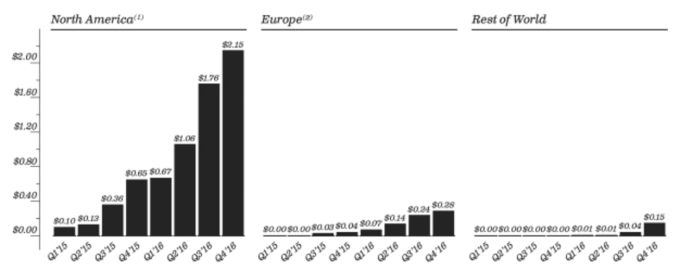
snap arpu

Snap says its users visit Snapchat more than 18 times every day, and 60% of its DAUs use the the chat service. So again, while it’s not as massive as other platforms, Snap is making the case that it’s one of the stickiest __apps out there. On average, over 25% of Snap’s DAUs post to their Snapchat story every day, and the company says over 2.5 billion Snaps are created every day.

Users

Snap has stressed its focus on daily active users (DAUs) as its pitch to investors and advertisers. That’s partly because it doesn’t have the same insane scale of Facebook — in terms of DAUs or MAUs. The company is trying to convince Wall Street that its engagement metrics make it a much more attractive platform. So, it might not have huge numbers, but with more than 150 million DAUs and stronger engagement than other platforms, it may turn out to be a more intriguing use of advertising budgets.

The company says it has 161 million daily active users as of the end of December last year, up from 110 million at the end of December in 2015. The majority of its use base is naturally in North America, with 69 million DAUs. Europe accounts for 53 million DAUs, there are 39 million DAUs in the rest of the world. Below is the chart the company gave in terms of average number of daily active users on a quarterly basis:
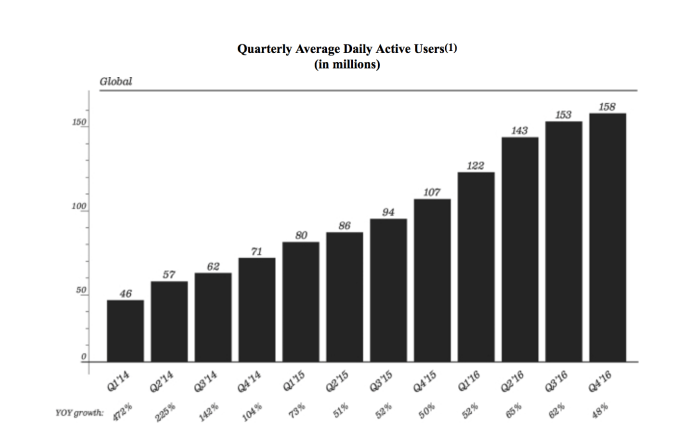
screen-shot-2017-02-02-at-1-38-43-pm

Diving deeper into international, it looks like the company’s growth across all three categories is pretty similar. While the U.S. is not growing as quickly year-over-year, all three categories that Snap has broken out are growing more than 40% year-over-year on a quarterly basis. We do, indeed, see slowing growth however across all categories if you look at a more quarter-over-quarter basis — especially beyond Europe and North America, where there was no change.

snap international users

You can find a deeper dive on Snapchat’s users and growth here.

Hardware & Spectacles

Snap said it would be expanding Spectacles distribution this year, but didn’t offer a whole lot of insight beyond that.

You can find a deeper dive on Snapchat’s hardware and spectacles details here.

Risks and other existential threats

Snapchat’s risk factors included plenty of the boilerplate threats to its existence — keeping talent, managing burn and so on. But Snap in particular has acknowledged a lot of new issues that have become more and more prevalent in recent years. Snap lists the platform’s usage for terror-centric content in addition to other kinds of illicit content. And the United Kingdom’s decision to exit the European Union (or Brexit) also places a shadow over the company given its operations in the U.K.

Another interesting risk factor listed by the company is that given that the IPO is an offering for non-voting stock (founders Evan Spiegel and Bobby Murphy have essentially full control of the company), it may be unpredictable. Here’s the money quote: “We therefore cannot predict the impact our capital structure and the concentrated control by our founders may have on our stock price or our business.”

Snapchat’s growth also declined rapidly following the launch of Instagram Stories. While we can’t say for sure that Instagram Stories was the culprit, Snap’s quarter-over-quarter growth rate dropped off to low single-digit percentage points after Instagram Stories’ launch in August.

You can find a deeper dive on some of Snapchat’s biggest risks here.

Google Cloud

As part of the IPO, Snap laid out its huge dependency on Google Cloud and some of the potential problems it may face going forward by existing on Google’s infrastructure. While using Google Cloud may help keep costs low, it also means that it’s beholden to any major (though probably unlikely) changes the company might make. Snap said it would commit $2 billion over 5 years for Google Cloud infrastructure.

You can find a breakdown of Snap’s relationship with Google and use of Google Cloud here.

Acquisitions

Snap gave us some additional detail on some acquisitions it made over the course of the year, in which the company never gave a final price. Snap paid $150.6 million for Looksery and $64.2 million for Bitstrips. It also paid $114.5 million for Vurb.

You can find a list of some of the acquisitions identified by Snapchat here.

Diversity

Snap briefly touched on diversity within the company, which now has nearly 2,000 employees. It didn’t break out specifics, but said the company believed “diversity is about more than numbers.”

You can find a deeper dive on Snapchat’s notes on diversity here.

Co-founder Reggie Brown’s lawsuit

Snap settled its major lawsuit with ousted co-founder Reggie Brown over alleged IP theft in 2014, paying out $157.5 million. The amount was never disclosed, so we’re finally getting a glimpse at what happened in the checkbook there.

You can find a deeper dive on the Reggie Brown lawsuit here.

Featured Image: Snap

February 3, 2017

GoPro gives the Karma drone another try

The GoPro Karma drone is now available for purchase. The camera maker today announced the general availability of the drone and at writing, it’s available from GoPro.com, and other retailers like Best Buy, B&H Photo Video and Amazon. Buyers can opt for the Karma drone bundled with a GoPro Hero 5 for $1099 or $799 without a camera.

This is GoPro’s second try at the Karma drone. The company released the drone last October but recalled it 16 days later after drones started falling from the sky. GoPro discovered that the battery was slightly popping out of place, causing power loss. CEO Nick Woodman later told me at CES that the drone can be fixed with a piece of tape to hold the battery in place.

During my time with the drone, I found it to be a capable product that preformed admirably. It’s not the fastest nor packed with the latest technology, but it’s by far the easiest drone to fly and thanks to the GoPro Hero 5 camera, the picture quality is superb. And now the drone will hopefully stay in the air.


GoPro Karma Review

February 1, 2017

The Amazon Echo is having its mainstream moment

The little talking speaker that could, Amazon’s Echo, is moving into the breakout phase of its success, according to data collected by analysts firm Slice Intelligence. The Echo is coming off a tremendously successful holiday shopping season, which saw not only a high volume of sales, but a key evolution in consumer demographics that’s driving sales from a broader cross-section of buyers.

Slice found that 50 percent of revenue related to Echo came from women, a trend which is a big change from the patterns at device launch, when overwhelming men tend to be the ones buying Echo. Slice identified this tendency originally around the launch of the first Echo, and now again during this most recent holiday season around the release of the new Echo Dot.

That’s not the only sign that Echo is going mainstream, however. Slice notes that Generation X and Baby Boomer cohort consumers are also driving a significant amount of Echo purchases, which is another key indicator of wider market penetration, since millennials tend to be more early adopters for tech and gadgets.

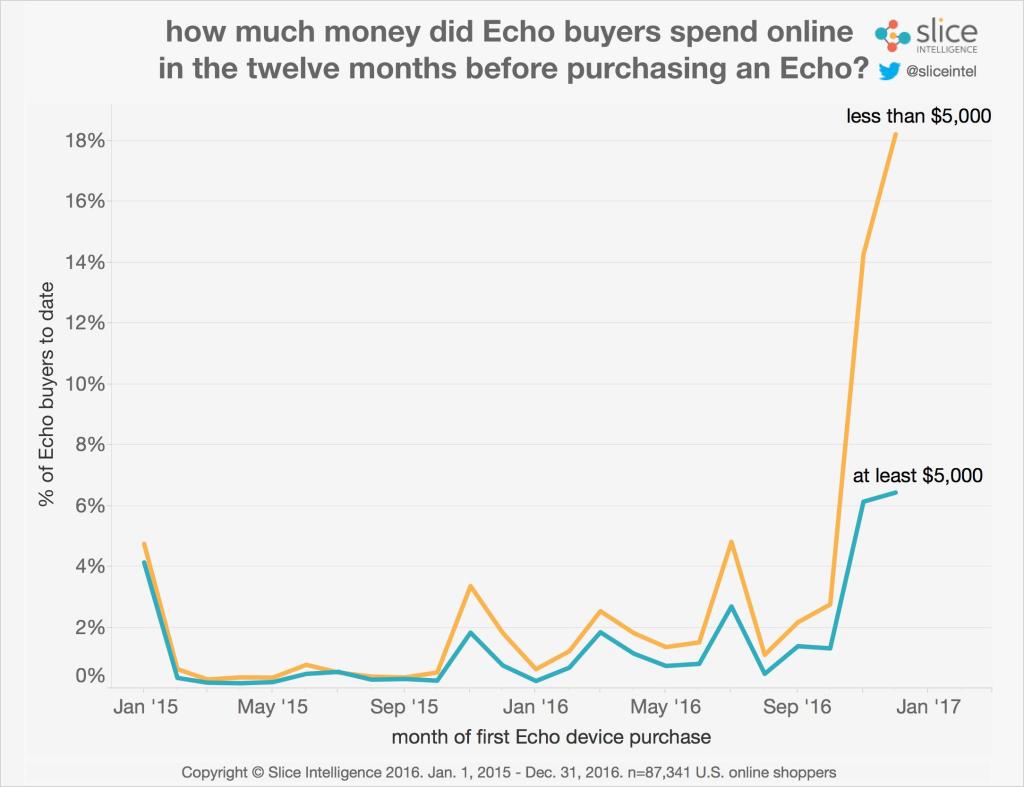
avg-spend-pre-echo-by-group

Slice also found that regular ecommerce shoppers made up a huge percentage of early Echo buyers, but that now first-time Echo buyers are not necessarily heavy online shoppers, which is also in keeping with more mainstream spending habits.

Unsurprisingly, Slice also found that the very affordable Echo Dot was the most popular option over the holidays, while the Echo followed fairly closely in second place, and the Tap earned only a tiny fraction of sales according to its data. The Echo in general saw sales surge significantly between November and December, with Cyber Weekend essentially doubling sales on any other day combination. Amazon had stock-outs for a significant portion of the holiday season, thanks to strong consumer appetite.

Echo’s growth and mainstream momentum is huge news for both the company and for voice-based interfaces, since it means a lot more people who otherwise might not be used to speaking aloud to accomplish any computing will now have regular exposure to that interaction method.

January 31, 2017

Fake news inquiry: Facebook should verify stories

It is one of the measures MPs will consider as part of an inquiry into the spread of fake news on the internet which is being launched on Monday.

Damian Collins said the big social media platforms had to start taking responsibility for the proliferation of stories that are not true.

The Tory MP suggested the Government could also ask Facebook to investigate where fake news is coming from, seek out the locations of fake news firms and the servers they are using.

:: MPs want to question tech bosses on fake news

Chairman of the Commons Culture, Media and Sport Committee
Video: Facebook should mark up true and fake stories

Speaking to Sky News, Mr Collins highlighted the scale of the problem saying that in the last three months of the US election campaign the top fake news stories had more shares than top legitimate stories.

Mr Collins made clear it was the big media firms and social media platforms he expected to take action.

He said: "In Germany where they have an election coming up, the German government has asked Facebook to look at the way that news is shared on Facebook because it is so concerned."

Mr Collins added he would like to see "verification tags" on sources of news on Facebook so people will know the stories are coming from a trusted source.

He said: "Just as major tech companies have accepted they have a social responsibility to combat piracy online and the illegal sharing of content, they also need to help address the spreading of fake news on social media platforms."

There was also a need to educate people in how to spot fake news to help them check the veracity of a story before sharing it with others, he added.

:: Facebook's fake news threatens democracy

As part of the inquiry by the Commons Culture, Media and Sport Committee, MPs will look at the impact fake news stories have had on specifics events, such as the EU referendum.

A collection of fake news headlines
Video: How to spot fake news online

Some of the top fake news stories of the last year included the Queen threatening to abdicate if Britain voted to leave the EU and the Pope endorsing Donald Trump for President.

Children's entertainer Dave Benson Phillips told Sky News how a fake news report he had died in a car crash had a major impact on his life.

He said he hoped the inquiry would result in strong measures to stop the scourge of fake news.

Dave Benson Phillips
Video: Dave Benson Phillips was a victim of fake news

Benson Phillips, star of Get Your Own Back, said: "A lot of people took it on face value that I had in fact been killed in a car crash.

"We hadn't really recognised how big the impact was going to be until we found ourselves going to theatres who said 'we've re-booked your show because we thought you were dead'.

"Without sounding too emotional about it, it affected me a lot.

"The person who it affected the most was my mum. She found out the news from a work colleague and was very upset."

:: Read more

:: Facebook's fake news threatens democracy
:: MPs want to question tech firms on fake news
:: Google plans to punish websites publishing fake news

Tim Peake talks space to Sky News in 60 seconds

Cannibal hamsters eat their babies due to corn diet in France

The rodents have in the past fed on a rich variety of grains, roots and insects.

But due to changing farming practices with an emphasis on industrially grown maize or corn, their diet is limited and imbalanced.

They are missing out on important vitamins like B3, or niacin, their habitat is "collapsing" and they are being turned into cannibals, believe experts.

Harvester
Image Caption: Changing farming practices have been blamed for the cannibalistic behaviour

The European hamster, also known as Cricetus cricetus, is critically endangered in western Europe.

Scientists carried out laboratory tests on the animals, with some mothers living on wheat and corn-based diets as well as clover or worms, and others who just had corn.

About 80% of the babies whose mothers had a varied diet were weaned - but only 5% of the offspring of the females fed corn made it to that stage - with the rest eaten.

The scientists said: "Females stored their pups with their hoards of maize before eating them. Pups were still alive at that time."

The mothers also ran around in circles, "climbing and pounding their feeders," when scientists entered the room.

The rodents had swollen and dark tongues, and blood so thick it was difficult to draw for samples, it was recorded.

However, when the hamsters were given the vitamin B3 in their corn diets, their symptoms disappeared and they stopped eating their young.

Vitamin B3 deficiency has been linked to 'black-tongue' syndrome in dogs, and a condition in humans called pellagra, also known as the "3-D" disease: diarrhoea, dementia and dermatitis, such as eczema.

"Improperly cooked maize-based diets have been associated with higher rates of homicide, suicide and cannibalism in humans," the researchers said.

Gerard Baumgart, president of the Research Centre for Environmental Protection in Alsace and a hamster expert, said: "There's clearly an imbalance. Our hamster habitat is collapsing."

He added: "Monoculture in agriculture is really bad for biodiversity. Now we need to take concrete action."

British astronaut Tim Peake to return to space on a second mission

He made the surprise announcement at the Science Museum on Thursday as the spacecraft that transported him to the International Space Station and back last year went on display at the London attraction.

Major Peake told Sky News he was "hugely excited" about returning to space.

Tim Peake launched into space for the first time in 2015
Video: Tim Peake's first journey into orbit in 2015

"It's what every astronaut wants to do," he said.

"Myself and my classmates from 2009, we are all going to get the second mission to the space station, which is wonderful.

"The work that is being done on board the space station is incredibly important and also tremendously exciting as well.

"It is only natural to want to return. The one thing you miss is the view of planet Earth, of course. It is the most spectacular thing you can possibly see.

"But also being involved in the space programme is hugely rewarding."

The Science Museum tweeted: "Thrilling news that @astro_timpeake will return to space on a second @esa mission to the @Space_Station #Soyuz."

Thrilling news that @astro_timpeake will return to space on a second @esa mission to the @Space_Station #Soyuz pic.twitter.com/kPSYIpTtbZ

— Science Museum (@sciencemuseum) January 26, 2017

The Russian Soyuz space capsule is the first flown human spacecraft acquired by the museum for the UK's national space technology collection.

Standing next to the spacecraft which brought him back home after his first 115-day mission on board ISS, Major Peake added: "It is wonderful to see it ... still bearing the punishment scars of coming back to Earth through Earth's atmosphere.

"The last time I saw this was in Kazakhstan in June last year. It is wonderful to have this here in London."

British astronaut Tim Peake working on the ISS
Video: Tim Peake talks space to Sky News in 60 seconds

In an interview with Sky News at the time, he said he would return to the ISS "in a heartbeat".

Asked by Sky's Harriet Hadfield at the Science Museum when stargazers could look forward to seeing him return to space, he replied: "That time will have to be decided by the European Space Agency."

Moody and neurotic? It could be down to your brain shape

A team at Cambridge University studied brain imaging from 507 people to try and link the shape of our brains with five key personality traits.

The team concluded that the outer layer of the brain - similar to the skin of an apple - is thicker and the brain less folded in neurotic people who are prone to mood changes and psychiatric disorders.

Individuals with 'open' personalities linked to curiosity and creativity show the opposite. The outer layer of their brains is thinner and the brain more folded in certain regions, with a greater surface area.

Researcher Dr Luca Passamonti says that long-term applications could include early diagnosis of severe anxiety and other psychiatric disorders.

He says the research shows evidence of a compromise within the human brain.

Dr Passamonti and others have identified the connections between brain shape and personality.    Pic: Cambridge Independent
Image Caption: Dr Passamonti and others have identified the connections between brain shape and personality. Pic: Cambridge Independent

"Evolution has shaped our brain anatomy in a way that maximises its area and folding at the expense of reduced thickness of the cortex," he said.

"It's like stretching and folding a rubber sheet - this increases the surface area, but at the same time the sheet itself becomes thinner."

This stretching has allowed the human brain to expand rapidly without becoming too big for our skulls. It continues throughout our lives.

Psychologists break down human personality into five traits: neuroticism; openness; extraversion/enthusiasm; agreeableness (a measure of altruism); and conscientiousness (a measure of self-control).

The Cambridge researchers say that as we get older neuroticism decreases and we become better at handling emotions.

Meanwhile, the traits of conscientiousness and agreeableness grow more pronounced with age. As a result, people tend to become more responsible and less antagonistic as they get older.

Neuroscientist and MIT lecturer Dr Tara Swart says the new Cambridge research bolsters earlier evidence that the right sort of brain 'training' creates a measurable, physical benefit in the human brain.

Neuroscientist Dr Tara Swart, speaking at London
Image Caption: Neuroscientist Dr Tara Swart, speaking at London's Corinthia Hotel in 2016.

"'Training' in this case means how we are brought up, educated, who we socialise with and also how much time we spend on mindfulness activities," she said.

"Mindfulness activities include yoga, 'mindful' walking, eating and quiet time in nature without digital devices. It's not just sitting cross legged and meditating.

"Studies have shown that just 12 minutes of mindfulness a day or 30 minutes of mindfulness three times a week leads to increased gyrification - in other words, more folds - in the pre-frontal cortex, enabling it to work better."

Tim Peake's first journey into orbit in 2015

New Samsung Galaxy Tab S3 To Be Announced At MWC Next Month

Samsung Galaxy Tab S3

Earlier this month the new Samsung Galaxy Tab S3 showed up in some benchmarks and now it looks like Samsung will unveil the device next month.

The Samsung Galaxy Tab S3 will be made official at a press conference on the 26th of February 2017 and we have some more information on the tablet.

According to Naver the tablet will come with a 9.6 inch display with a resolution of 2048 x 1536 pixels, this ties in with the benchmarks we saw recently.

The tablet will come with a Qualcomm Snapdragon 820 processor and an Adreno 530 GPU, it will also come with 4GB of RAM and 32GB of built in storage.

Other specifications on this new Samsung Galaxy Tab S3 include a 5 megapixel front facing camera and a 12 megapixel rear camera, the tablet will come with Android 7.0 Nougat.

We will have full details on the new Samsung Galaxy Tab S3 tablet along with some photos of the device at Mobile World Congress next month.

Source Naver, Android Central

Filed Under: Android News, Tablet News

Popular Geeky Gadgets Deals