December 24, 2016
Police unit removes 250,000 terror items from internet
The UK's Counter Terrorism Internet Referral Unit (CTIRU) has also said that far-right extremist material is on the rise.
The CTIRU was set up in 2010 and works with internet giants like Facebook and Twitter to take down social media posts, images and videos.
It now removes 2,000 pieces of content each week.
Detective Chief Superintendent Clarke Jarrett, from the Counter Terrorism Command, told Sky News: "It's a really important role as part of the counter terrorism network.
"We also think that it's a big dent in the amount of propaganda that extremist groups put out there."
The CTIRU's officers scour the internet looking for terrorist material but also rely on public referrals through an anonymous tip line.

Examples taken down include movies glamorising Islamic State fighters or idealising civilian life inside their self-proclaimed caliphate, or more direct messages urging would-be recruits to buy knives from hardware stores to carry out attacks.
The CTIRU has so far removed 249,091 pieces of material from the internet since 2010, working with more than 300 different companies.
This year was its busiest, with 121,151 pieces removed - more than double 2015 when 55,556 were taken down.
Mr Jarrett also said the unit had noticed an uptick in far-right extremist removals, with more members of the public referring that type of content, although he did not give a specific figure.
However, the vast majority is still related to jihadism and the material is sometimes implicated in real-life terror cases.
Junead Khan, from Luton, was convicted this year for plotting to attack US soldiers with knives and potentially detonate a homemade bomb.
Met Police officers found graphic videos and images of soldiers being tortured by IS. The CITRU has sought to remove that material from the internet.
Mr Jarrett also said the unit had good relations with tech companies, but that these "could improve".
December 22, 2016
Uber slams brakes on self-driving car in San Francisco
The company had been locked in a row with the California Department of Motor Vehicles since the trial in San Francisco began.
The agency said it had decided to revoke the registration of 16 Uber Volvo vehicles on the grounds they were not properly registered to operate in driverless mode. The state had previously threatened court action.
Uber responded that while it had agreed to take the cars off the road, it was not obligated to have the permit in question because its vehicles require continuous monitoring by a person in the car.

The cars, it explained, have someone behind the controls at all times and an engineer in the passenger seat.
"We're now looking at where we can redeploy these cars but remain 100% committed to California and will be redoubling our efforts to develop workable statewide rules," a spokeswoman said.
The permit requires the company to provide the department with more information - mostly related to safety.
The regulator has pledged to help Uber receive the correct documentation, should it submit the application, amid protests from the company that the state is favouring complex rules over innovation.
There are about 20 other companies battling to win the technology race including Google, Tesla and Ford.
Robot gives rare glimpse of hidden world under Antarctic sea ice
A camera attached to the robot by the Australian Antarctic Division (AAD) captured an underwater scene filled with coconut-shaped sponges, dandelion-like worms, pink algae and spidery starfish.
The remotely operated vehicle was sent down by scientists through a small hole drilled in the ice as they recorded the acidity, oxygen, salinity and temperature of the seawater.
Recorded near Australia's Casey research station, the footage shows what life is like for creatures living in water that is -1.5C (29.3F) all year round and covered in 1.5m (4.9ft) of sea ice for 10 months of the year.
AAD biologist Glenn Johnstone said: "When you think of the Antarctic coastal marine environment, the iconic species such as penguins, seals and whales usually steal the show.

"This footage reveals a habitat that is productive, colourful, dynamic and full of a wide variety of biodiversity, including sponges, sea spiders, urchins, sea cucumbers and sea stars.
"Occasionally an iceberg may move around and wipe out an unlucky community, but mostly the sea ice provides protection from the storms that rage above, making it a relatively stable environment in which biodiversity can flourish."
Scientists are in Antarctica to learn more about the impact of acidification on Southern Ocean sea-floor communities under increasing carbon dioxide emissions.
Project leader Johnny Stark said a quarter of the carbon dioxide emitted into the atmosphere was absorbed by the ocean, increasing acidity.
He said: "Carbon dioxide is more soluble in cold water and polar waters are acidifying at twice the rate of tropical or temperate regions.
"So we expect these ecosystems to be among the first impacted from ocean acidification."
'Bionic eye' implants offer hope for blind NHS patients
Five patients with retinitis pigmentosa will be treated at the Manchester Royal Eye Hospital and five at Moorfields Eye Hospital in London in 2017.
They will be given a pair of glasses mounted with a camera which captures light and sends wireless signals to an implant in the retina.
The implant then sends information to the brain to help patients regain some sight.
Professor Paulo Stanga, from Manchester Royal Eye Hospital, was involved in trials using the Argus II Bionic Eye to treat the condition.

He said: "I'm delighted that our pioneering research has provided the evidence to support NHS England's decision to fund the bionic eye for the first time in patients.
"It surpassed all of our expectations when we realised that one of the retinitis pigmentosa patients in Manchester using the bionic eye could identify large letters for the first time in his adult life."
The procedure will be funded as part of a scheme that assesses treatments that show promise for the future.
Patients will be monitored for a year to see how they implant improves their lives.

Keith Hayman, from Lancashire, had the bionic eye fitted during a trial at the Manchester hospital in 2009.
The 68-year-old, who was diagnosed with retinitis pigmentosa in his 20s, had to retire as a butcher in 1981 when he became blind.
He said: "Having spent half my life in darkness, I can now tell when my grandchildren run towards me and make out lights twinkling on Christmas trees.
"When I used to go to the pub, I would be talking to a friend, who might have walked off and I couldn't tell and kept talking to myself."
Dr Jonathan Fielden, director of specialised commissioning at NHS England, said: "This highly innovative NHS-funded procedure shows real promise and could change lives.
"Now once again the NHS is at the forefront of harnessing ground-breaking science for the benefit patients in this country."
The Argus II retinal implant, made by Second Sight, has also been trialled to treat those suffering from age-related macular degeneration - the most common cause of sight loss in the developed world with between 20 and 25 million sufferers worldwide.
Snap Inc. has a new China tech R&D office focused on Spectacles

Spectacles seem to be a hit for Snapchat parent Snap Inc., thought their unconventional rollout via pop-up shops (including a new one at a Dave & Busters in Illinois this morning) makes it hard to judge the scale of their success. Here’s a decent indicator: Snap is opening a new research and development technology office in Shenzhen, near where Spectacles are assembled, CNN reports.
The Snap Inc. move is unusual because Snapchat itself isn’t available to users in China, since it’s banned in the country. But its first hardware product, the video-capturing Spectacles sunglasses, are assembled there (as are a large percentage of mass market consumer electronic devices).
Snap’s new Shenzhen office only has 20 employees so far, but the company is actively recruiting from the likes of Alibaba, Baidu and Tencent to build out its team further. It’s also offering stock incentives and the ability to transfer to Snap’s U.S. operations as hiring benefits, according to CNN.
It’s not unusual for gadget makers to set up R&D facilities near their supplier assembly operations. Apple announced a research and development center in Shenzhen in October, for instance – the second such facility it revealed this year, as it also discussed plans to bring an R&D office online in Beijing in August.
Basically this strongly suggests that Snap Inc. isn’t through with its hardware plans. Spectacles has been positioned as a “toy” by Snap CEO Evan Spiegel, but the company also now bills itself as a “camera company,” and this is another indicator that it could have more extensive hardware ambitions.
Artificial leaf captures light to power drug production

Drug production is generally a matter of big factories churning out millions of aspirin or ibuprofen tablets a day, but there’s a lot to be said for manufacturing common drugs on a small scale, close to where they’re used. Researchers from the Netherlands have created an efficient and simple method for doing so that uses a method much like plants have for making their own resources.
Artificial leaves aren’t new: they’re a class of device which passively converts light into power for various purposes. Plants, of course, use photosynthesis to build their own critical chemicals, but they’re much better at it than our best imitations. In a significant step forward, however, Timothy Noël and his team at Eindhoven University of Technology have found a way to make them power chemical reactions, such as those needed to assemble medical molecules.
Related Articles
More Details On MIT's "Artificial Leaf" (And Video) MIT's shape-shifting 3D-printed objects could improve medicine and solar-power High schooler's 3D printed 'mini-brain' bioreactor accelerates Zika researchThe use of LSCs immensely improves the efficiency, making more complex and high-energy processes possible to carry out — even on cloudy days.
“We now have a powerful tool at our disposal that enables the sustainable, sunlight-based production of valuable chemical products like drugs or crop protection agents,” said Noël in a TUE news release. “Using a reactor like this means you can make drugs anywhere, in principle, whether malaria drugs in the jungle or paracetamol on Mars. All you need is sunlight and this mini-factory.”
For the next few missions, it’s probably simpler to just pack a bottle of pills, but for long-term production in resource-poor areas, this could certainly be a useful technology. The discovery is detailed in the researchers’ paper, published today in the journal Angewandte Chemie.
Featured Image: Eindhoven University of TechnologyDecember 21, 2016
U.S. wearables market is doing much worse than expected

Apple may still be claiming that sales of its Apple Watch are “doing great,” but overall, the wearable device category is failing to grow at the rates forecasted earlier. According to a new report from eMarketer, wearables like Apple Watch and Fitbit were expected to grow more than 60 percent year-over-year from 2015 to 2016. However, the firm is now cutting that estimate down to just 25 percent growth this year.
“Smartwatches in particular,” the report said, “have failed to impress customers.”
Unlike other device categories, wearable devices have struggled to gain traction beyond early adopters. And with smartwatches, consumers struggle to find a reason to buy.
eMarketer analyst Nicole Perrin pointed out that before Apple Watch arrived on the scene, fitness trackers dominated the space. Today, fitness and health tracking remain one of the key selling points for the new crop of wearable devices, Apple Watch included.
But Apple hasn’t convinced everyone that a smartwatch is something they need, especially given the higher prices compared with standard fitness trackers for the watch’s enhanced functionality.
“Without a clear use case for smart watches—which have more features than fitness trackers, but significant overlap with smartphone functionality—the more sophisticated, expensive devices have not caught on as quickly as expected,” said Perrin in the report.
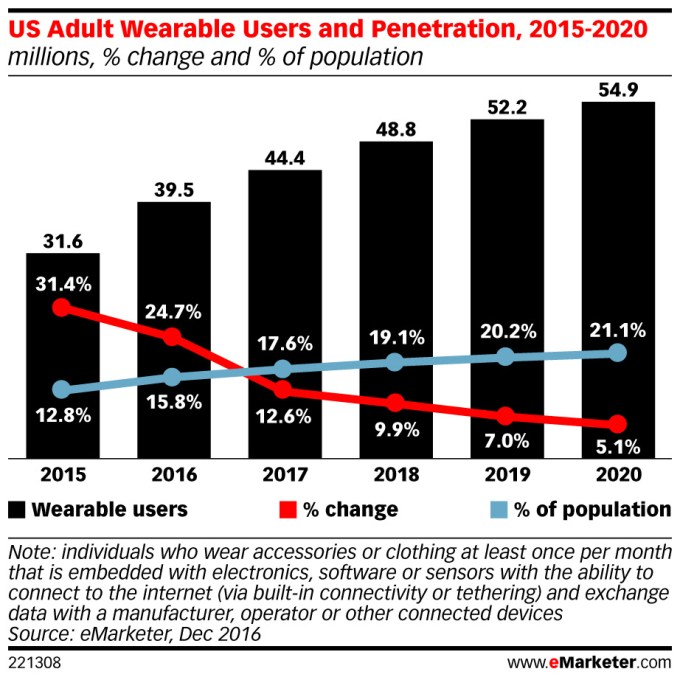
The firm estimates that 39.5 million U.S. adults will use a wearable device with internet connectivity at least once per month. However, this is much less than the 63.7 million eMarketer predicted back in October 2015. Use of wearable devices will only reach 15.8 percent of the population, and is only expected to grow to 21.1 percent by 2020.
eMarketer isn’t the only firm noting the troubles in the wearable market. This month, IDC reported smartwatch numbers were on the decline, with Apple dropping to fourth place after a 71 percent year-over-year decline in total shipments. Fitbit instead won the category with 23 percent of the market and 5.3 million units shipped in the quarter.
But even Fitbit could be struggling. New reports indicate that Fitbit’s Charge 2 may not be selling as quickly as expected, based on channel checks that found its inventory to be “particularly bloated,” along with weak demand for its Flex 2.
In addition, IDC had said this past October that smartwatch sales were tanking, with total shipments down 51.6 percent from the same time last year.
Apple had responded to IDC’s latest report not with hard numbers, but by touting the Apple Watch’s success as compared with its own prior sales. Apple CEO Tim Cook said that Apple Watch sales hit a record during the first week of holiday shopping, and that the current quarter is on track to be the best yet.
It’s not surprising that the Apple Watch sold better than before during the 2016 holidays – after all, this is the time of the year where people tend to increase their spending. Plus, Apple released a new version of its smartwatch ahead of the holiday season which likely contributed to the bump.
But that bump may not save the wearable category as a whole.
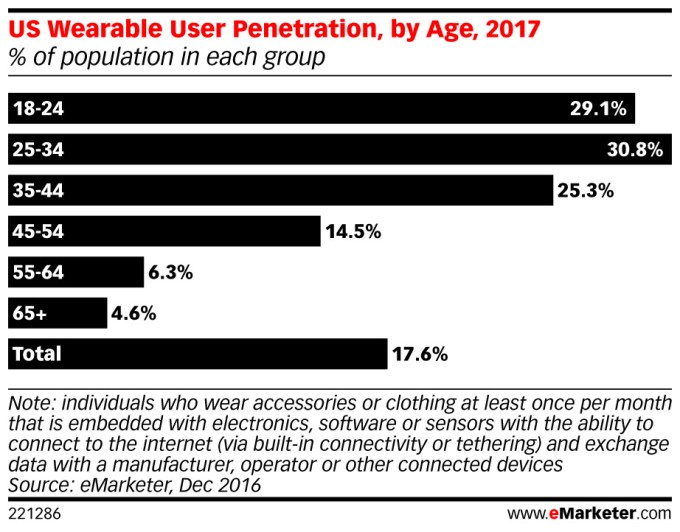
eMarketer’s new report also noted that younger people are more interested in wearables, as around 30 percent of those 18 through 34 will be wearable users in 2017 – a figure that’s 17.6 percent higher than the overall population.
Wearable early adopters also skewed male, until the shift toward fitness trackers, the report also found. By 2018, more wearable users will be female, it’s now forecasting.
Moth eyes inspired the design of this hypersensitive camera

If you wanted to see in the dark, you could do worse than follow the example of moths, which have of course made something of a specialty of it. That, at least, is what NASA researchers did when designing a powerful new camera that will capture the faintest features in the galaxy.
This biomimetic “bolometer detector array,” as the instrument is called, is part of the Stratospheric Observatory for Infrared Astronomy, or SOFIA. This ongoing mission uses a custom 747 to fly at high altitudes, where observations can be made of infrared radiation that would otherwise be blocked by the water in our atmosphere.
Related Articles
NASA tech could track firefighters where GPS can't reach The International Space Station's network bandwidth will be doubled by new upgrades GIFs in space! NASA makes an official channel on GiphyThe eye of the common moth, however — or at least, a design inspired by it — did what the latest nanomaterial didn’t. Insects’ eyes are of course very different from our own, essentially composed of hundreds or thousands of tiny lenses that refract an image onto their own dedicated photosensitive surface at the base of a column or ommatidia. In moths, this surface is also covered in microscopic, tapered columns or spikes. These have the effect of preventing light from bouncing back out, ensuring a greater proportion of it is detected.
The team replicated this design in silicon, and you can see the result at top. Each spike is carefully engineered to reflect light downwards and retain it, making the High-Resolution Airborne Wideband Camera-plus, or HAWC+, one of the most sensitive instruments out there. Funnily enough, the sensor they modified was originally called the backshort under-grid sensor — BUGS.
 HAWC+ not only pulls in light from the far end of the infrared spectrum, but measures its polarity. This means the slightest changes in the light’s nature or origin will be detected. Dim features and events like early star formation and the black hole at the center of the galaxy can be observed more closely than ever before.
“You can be inspired by something in nature, but you need to use the tools at hand to create it. It really was the coming together of people, machines, and materials. Now we have a new capability that we didn’t have before,” said Wollack in a NASA news release. “This is what innovation is all about.”
SOFIA is underway, but the new sensor was just commissioned, so it’ll be a while before it can be built to spec and integrated with the rest of the platform. You can keep up with it and the rest of the observatory’s science on the mission webpage.