Pages

November 3, 2014

This Ambulance Drone Can Fly Into Trouble With First Aid

A Dutch engineer has created a flying defibrillator for emergency situations. The drone, called the Ambulance Drone, would be stationed at various points in the city. In an emergency, people on the scene can call it in and it arrives a few seconds later. The built-in defibrillator unit can be used by anyone and it allows doctors to monitor the situation after the shocks are administered.

The drone includes a webcam and loudspeaker and allows remote doctors to walk people on the scene through the process of attaching the electrodes and preparing the defibrillator. The creator, Alec Momont of TU Delft’s Faculty of Industrial Design Engineering, said that 20% of people can operate a defibrillator without instruction and the number rises when they have prompts from trained personnel.

‘Some 800,000 people suffer a cardiac arrest in the EU every year, and only 8% survive,’ Momont explains. ‘The main reason for this is the relatively long response time of the emergency services (approx. 10 minutes), while brain death and fatalities occur within 4 to 6 minutes. The ambulance drone can get a defibrillator to a patient inside a 12 km zone within one minute. This response speed increases the chance of survival following a cardiac arrest from 8% to 80%.’

The system is still in prototype stage but there is a good chance it could be launched in five years for about $20,000 each. Drones are still not allowed to fly autonomously so they can’t wing their way around downtown Delft with their helpful payload… yet. It will be interesting to see these robots flying around one day, dropping first aid when needed.

Jony Ive Is So Focused On Design He Doesn’t Know Apple’s Key Financial Numbers

Apple design lead Jony Ive spoke to an audience at the San Francisco Museum of Modern Art last night, the Wall Street Journal reports, addressing the difficulties in designing an Apple smartwatch. The Apple Watch design process was “difficult and humbling” because of the expectations consumers have with regards to wearable tech and fashion, Ive said, but perhaps his most interesting comment was about his lack of awareness when it comes to Apple’s top and bottom line financials.

Ive made a point about Apple’s focus on product design above other concerns, suggesting that the company is worthy of applause for embracing the ethos that products come first, and profits will follow. To drive home his point, Ive made the surprising confession that he’s not familiar with the actual numbers Apple announced during its most recently quarterly earnings, including its annual revenue of $183 billion, or its $40 billion in profit for its fiscal 2014.

“I honestly don’t know the numbers,” Ive remarked, per the WSJ. “But I know they are high.”

Though Ive professing not to have specific knowledge of the company’s financials might seem odd for a high-level executive reporting directly to the CEO, the celebrated designer is known for his focus on product design, and the fact that he doesn’t pay that much attention to the company’s fiscal performance is a credit to the company’s long-stated belief of putting product before a desire to make money, with the argument being that customers will reward top-quality device design.

Of course, the luxury of being able to focus entirely on product design and ignore money issues is also one afforded pretty much exclusively to companies that are doing well, so it’s not that surprising Ive is able to keep his head down in the studio.

The Apple Watch is set to debut early next year, and Apple is pushing it heavily in fashion circles, including with an editorial photography spread in Vogue and a special preview event in Paris during Fashion Week. It might be the Apple product whose fate rests most heavily on Ive’s shoulders, too, given how much attention has been paid to its design chops so far, and how important design is to a device that’s meant to be worn almost around the clock by its users.

Featured Image: Screenshot

GoPro Shares Spike As It Handily Beats Street Estimates

GoPro’s earnings for the third quarter were pretty as a picture for the company’s investors, with earnings coming in above analysts’ expectations

For the quarter, GoPro racked up sales of $280 million, up 45.7 percent from the $192.1 million reported in the third quarter of 2013. Adjusting for generally accepted accounting principles (GAAP), profits were $14.6 million, or 10 cents per share, compared to a $1.1 million, or 1 cent per-share, loss in the third quarter of 2013.

Analysts had predicted revenue of $265.6 million and earnings of 8 cents per share.

On a non-GAAP basis, GoPro earned $0.12 per share, putting its normally accounted for profit, and its adjusted profit in reasonable harmony. Companies like Twitter that have higher share-based compensation costs have larger negative deltas between their GAAP and non-GAAP profit margins.

The company, which has seen its stock price tumble from the peaks it reached in the first months after its public offering, was buoyed by a strong showing for its new line of cameras, which the company called the most successful launch in its history.

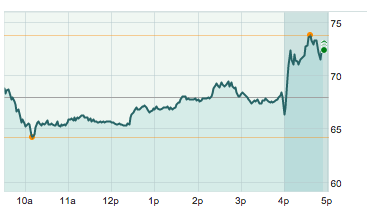
Shares were up over $5 or more than 7 percent in after-hours trading on the Nasdaq, as investors responded favorably to all the good news.

Here’s the chart:

Screen Shot 2014-10-30 at 1.54.13 PM

“The global scale and execution of our HERO4 launch made this the most successful roll out in GoPro’s history,” said GoPro founder and chief executive, Nicholas Woodman., who also touted advancements in the company’s desktop and mobile content management applications aimed at making it easier for GoPro owners to create and share content.

With the earnings, GoPro is sitting fairly pretty as it heads into the holiday season. As part of the bigger muscles the strong public offering afforded the company, Best Buy customers around the country can expect to see more of an in-store presence from the camera maker.

GoPro went public for $24 per share. It closed regular trading at $68.25, and is up past $72 in after-hours trading. Nascent media business or not, investors are happy with what they see. The company is worth around $9 billion.

Samsung Announces The Galaxy A5 And Galaxy A3, Its “Slimmest Smartphones To Date”

Samsung vowed to introduce more desirable phones when it revealed its disappointing Q3 2014 earnings yesterday, and it has wasted no time doing so after announcing the Galaxy A5 and the Galaxy A3 — two metallic devices that it calls its “slimmest smartphones to date.”

The Galaxy A5 and Galaxy A3 both dispense with the Korean company’s tradition of using plastic bodies. They are 6.7mm and 6.9mm thin, respectively, and both come with a five-megapixel front-facing camera. The Galaxy A5 is the higher spec’ed phone, with a five-inch screen, 2GB RAM, 1.2 GHz quad-core processor, and 15-megapixel camera on the back,

The Galaxy A3 sports a smaller 4.5-inch screen, with the same processor, 1GB of RAM and an 8-megapixel camera. Both run Android KitKat (4.4) and include support for 4G networks and a slot for Micro-SD memory cards.

galaxy a3 a5 2

Samsung’s revenue has stalled as Apple’s iPhones squeezes it at the top-end of the smartphone market — the iPhone 6 launches in Korea, following a huge number of pre-orders in Samsung’s home market — but these new Galaxy phones appear to be focused on China and the mid-tier market more generally.

The Korean firm says the Galaxy A3 and Galaxy A5 will launch in “select markets including China” in November. That Samsung is specifically mentioning China is interesting, since Xiaomi’s phones — which retail at $300 and $150, and have propelled it to No. 3 in the smartphone rankings — are impacting Samsung’s (and other phone makers’) business in the country. Lenovo already has plans to effectively clone Xiaomi with a new China-only business launching next year, but Samsung looks to be aiming to provide a premium-like experience on a more affordable budget with these new products — although the pricing for the Galaxy A3 and Galaxy A5 is yet to be revealed.

We contacted Samsung to ask which other markets the phones will launch in, and how much they will cost. We’ll update this post with any new information that we receive.

iCracked Technicians Have Made $6M This Year

iCracked

You’d think that competing directly with Apple for its own customers would be a losing game, but iCracked‘s iOS repair service continues to grow as Apple approaches 1 billion mobile devices sold — a threshold the company could pass this quarter.

In a phone interview last week, iCracked founder and CEO AJ Forsythe told TechCrunch that his company has brought in 280 more full- and part-time “iTechs” to its roster (bringing the total to 1,000) in the last two months, a big jump from the regular 60-80 per month it was recruiting earlier this year. Forsythe claims that the jump is the result of the company hitting its stride after three years of building out its support infrastructure and training systems for new technicians, which include approximately 22 hours of training, free tools and parts to do repair work, insurance for devices repaired, and an Uber-like routing system that lets iTechs find, setup, and complete repair jobs in less than an hour.

He also says that he expects that growth to continue, as 40% of requests that come in via the app come from areas where iCracked doesn’t yet have technicians available. In part, iCracked is benefitting from the fact that it’s easier to scale out individuals technicians that only do repairs than it is to roll out an Apple Store that needs real estate, inventory, and a full staff of employees.

While iCracked also offers repair (and reselling) services for Android devices, the realities of market fragmentation and the constant flow of new models from OEMs result in the startup only looking at roughly the top 10% of Android devices by sales. While that’s still a large market, it translate into only 20% of iCracked’s repair and reselling business.

So far this year, Forsythe says those iTechs have earned (after iCracked’s cut) $6 million. As with other services in the so-called “sharing economy,” he notes that incomes are skewed towards those who spend significantly more time doing repairs, with some technicians bringing in six-figure incomes. But as with Lyft drivers who only work weekends, many iTechs only make themselves available for jobs when they need some extra cash. For most repairs, Forsythe told TechCrunch that its techs make approximately $25 per hour, with that number going up in regions with higher demand. To make sure that those areas are always being serviced, iCracked actually hires some technicians full-time, a solution that its cousins in the sharing economy may also have to adopt to prevent service providers from simply jumping between competing apps.

Featured Image: iCracked

The Teeny iBox Nano 3D Resin Printer Reckons Small Is Beautiful

The Formlabs Form 1+ is a $3,299 stereolithography 3D printing machine that takes up a large chunk of desk space, and takes a similarly sizeable bite out of your savings. But what if there’s another way to get your hands on this type of 3D printing tech? Well, say hello to the teeny gizmo in the above video.

The iBox Nano, shown in time-lapse 3D-printing a chess piece, uses a similar type of 3D printing technology to Formlabs’ printers — specifically the Nano uses UV LEDs to cure resin prints — but it has a price-tag of just $299 because it’s small enough to hold in the palm of your hand.

Resin 3D printers differ to FDM (filament) printers, which extrude (typically) plastic filament to build up prints. Resin is better suited to finer detail than FDM, making the Nano’s focus on printing small objects appropriate.

The printer is powered by a low cost microcomputer Raspberry Pi, encased in a laser-cut clear acrylic box to save on manufacturing costs by doing away with the need for any injection moulding. Every little helps, as they say.

What’s the point of a really small 3D printer? The world’s smallest, the Nano’s Florida-based makers claims. They argue small is beautiful when it comes to 3D printers because costs come down on all fronts: the printer unit itself, the cost of the materials required to fulfill a print job, and the wait time for printing the object out.

Energy consumption is also cut down to size, and operational noise levels are reduced.

Founder Trent Carter says part of its market research involved polling around 100 households that have used 3D printers in the past 12 months, and it found most people “only print small things”.

“The reasons seem to stem from the long build times for large items, sometimes 10-12hours, and moderate cost of materials for 3D printing. If you have a printer that prints 4x4x4” and print an object that size it could take 14-18 hours and consume $30-60 of consumables. This varies based on the speed of the printer and the print material,” he tells TechCrunch.

“As you can see it is expensive and slow to print large objects. In contrast the Rook that you see printed in our video and in our closeup images measures 30mm x 20mm and took about 2 hours to print and consumed about 50 cents worth of resin!”

In terms of what exactly can be printed with such a dinky printer, Carter suggested items such as small models, jewelry, game pieces and toys, and small replacement parts. It is also possible to create larger items by printing them piecemeal and assembling into a large construction afterwards, using screws or glue.
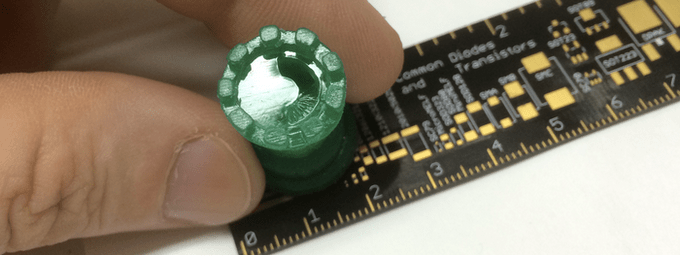
iBox Nano

The Nano’s maximum print resolution is 0.39 microns on the Z axis. (The smaller the number here the less banding on print outs.) Although printing at that ultra high resolution would increase the printing time, so it supports 100 microns if you want a quicker print. The total build area is 40 x 20 x 90mm.

Carter and co are currently raising crowdfunding on Kickstarter to turn their prototype into commercial shipping product. At the time of writing they are north of $275,000 raised, with a funding goal of $300,000 and 11 days left on their campaign.

Although they’re on Kickstarter the project is fairly well advanced at this point, with Carter noting that they have completed work on the Nano’s hardware — and have multiple alpha and beta units printing.

Extant work to complete before their shipping schedule of April 2015 is continued hardware testing of the beta production run of 100 units, and software dev work — including creating printing profiles for supported resins.

“The software is functional and being debugged and improved daily. We are adding features and testing. Because the software can be updated post-purchase there is little risk to our shipping schedule,” he says.

“A 3D printer needs a ‘Profile’ for every Resin supported, and for different build qualities such as layer thickness. We are adding these as they get through Q&A. Because these profiles can be downloaded from our site or from other users, we see little risk to our schedule. We have several Profiles finished today. More will be added as they become tested and certified.”

iBox Nano is not the first 3D printer maker to try shrinking the tech to cut the price tag down to a more consumer-friendly size. Earlier this year The Micro 3D printer raised more than $3 million on Kickstarter promising a compact FDM printer starting at $299, with a build area of 4.6 x 4.2 x 4.4″.

Check Out This Amazing Transparent Car

Spectrum has posted some amazing video of a “transparent” car created by Japanese researchers. The car uses projectors, cameras, and special mirrors to reflect what’s outside the car onto the surfaces inside. The resulting images allow you to see what’s going on all around the vehicle, even behind you and in blind spots.

Created by Susumu Tachi and Masahiko Inami of the Graduate School of Media Design at Keio University, the project is designed to help drivers stay aware of their surroundings. The technology isn’t new – this sort of video camouflage has been around for a while – but by shrinking it down and sticking it into a car you can do a sort of reverse camouflage. Instead of hiding objects with light, the projector renders the Toyota Prius in the video “transparent.”

Will we ever see a real version of this in cars? The creators write:

Next we built a setup specifically for a Toyota Prius that made the backseat virtually transparent, so that the driver could see everything behind the car when driving in reverse. In this application, the system had one projector and six lenses, allowing the driver to act naturally without the system’s having to track the movements of the driver’s head. The result is a panoramic view that the driver can use intuitively—quite unlike the current, counterintuitive system, which sends output from a rearview camera to a display mounted on the dashboard. We are now collaborating with several automakers and automotive electronics companies in turning our concept into a commercial system.

As you can see from the video above the technology is still pretty wonky. But with a brighter projector, better cameras, and a smaller enclosure and some day we’ll all feel like Wonder Woman on the highway.

This Week On The TC Gadgets Podcast: HP Sprout, New Fitbits, And Other Wrist-Worn Tech

Fitbit announced a few new devices, including the Fitbit Charge and the Fitbit Surge, both of which we’re excited about. Plus, HP is doing all kinds of weird things, not least of which is the announcement of an odd new computer, projector type device called the Sprout.

Plus, we’re still fascinated with the Apple Watch so we’re talking about all things wrist this week.

We discuss all this and more on this week’s episode of the TC Gadgets Podcast featuring John Biggs, Matt Burns, Darrell Etherington, and Jordan Crook.

Have a good Friday, everybody!

We invite you to enjoy our weekly podcasts every Friday at 3 p.m. Eastern and noon Pacific. And feel free to check out the TechCrunch Gadgets Flipboard magazine right here.

Click here to download an MP3 of this show.
You can subscribe to the show via RSS.
Subscribe in iTunes

Intro Music by Mendhoan.

HTC Reports Slim $19.7M Profit For Q3 2014 As Its Rebuilding Efforts Continue

Things seem better for HTC these days, after the Taiwanese phone company eked out a slim $19.7 million (NT$0.6 billion) profit for the third quarter of 2014. That figure represents a drop on the previous quarter’s $75 million profit, but is a big improvement on October 2013, when it suffered a $102 million loss in its first negative quarter as a public company.

HTC’s revenue dipped in Q3 2014, though. The firm recorded $1.38 billion (NT$41.9 billion) in sales, down from $2.17 billion in the previous quarter. Despite the fluctuation, HTC says that its top-billed HTC One (M8) and mid-range Desire line-up spent the last three months “holding their own or expanding their markets despite stiff competition.” The company did not provide actual sales or shipment figures, however.

HTC certainly has plenty of irons in the fire right now after refocusing its strategy following successive quarters of declining revenue, which culminated in that net loss last year.

The One (M8) is available in Android and Windows Phone flavors, it put the focus on selfies (see what I did there?) with the new Desire Eye and its 13-megapixel front-facing camera, its Desire 820 was the first Android phone to support a zippy 64-bit processor and it has a new attachable camera for your smartphone too. Then there’s the software side of things: HTC launched its Zoe photo app for Android and has plans to bring it to iOS.

The Taiwanese firm is predicting that it will round off the year with $1.38 billion – $1.55 billion (NT$43 billion to NT$47 billion) in revenue for its final quarter, with earnings per share of NT$0.07 to NT$0.46.

Let’s see if its devices can keep pace with new arrivals like Apple’s iPhone 6 and iPhone 6 Plus, and Samsung’s Note 4; not to mention Xiaomi, LG and Lenovo — each of which is on the up.

Hands On With Microsoft’s New Fitness Wearable, The Band

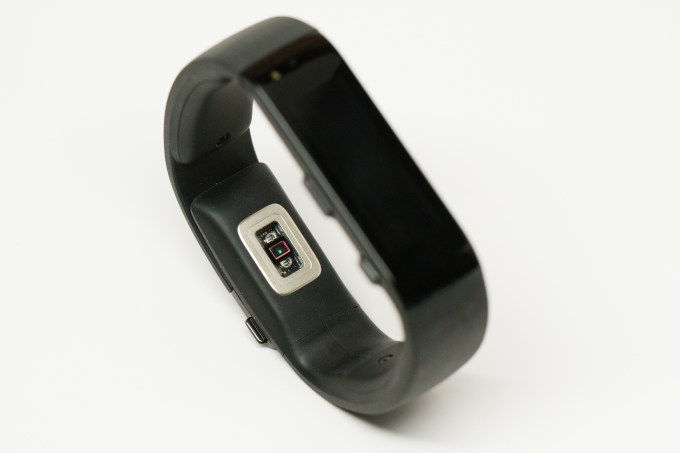
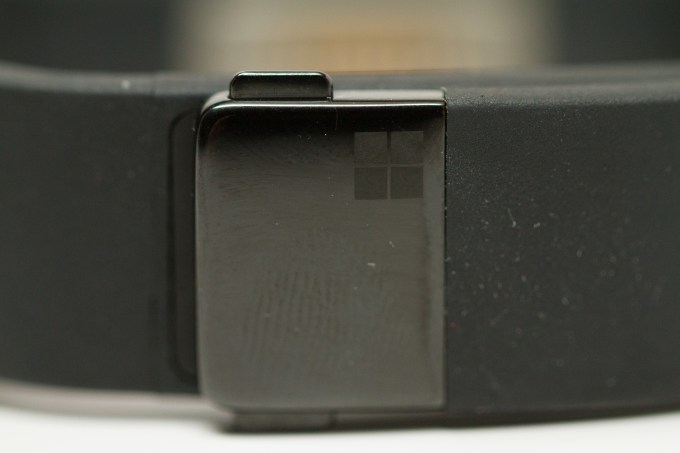
Dropping out of left field like a foul fly ball from the Kansas City Royals this week, the Microsoft Band was a surprise. Part fitness band, part computer, part mobile Twitter and stock-checking smartgadget, the Band is a mix of things.

And it pretty much works. It’s still a bit clunky, as you might expect from first-generation hardware, but I’ve been pleasantly surprised by the Band.

watchpics-14

Most importantly, it doesn’t do just one thing. If it were a fitness-only device, I wouldn’t use it. If it only had a few lightweight apps, I wouldn’t use it. If it were just a sleep tracker, or a heart-rate monitor, I wouldn’t use it. But with those features combined, it does enough to fit into my daily flow.

That’s to say that wearing something on your wrist is annoying. Having something else to keep charge is annoying. And having one more damn screen in your life is annoying. So, any device that wants to take up that spot has to more than balance out the debits that it will make on your arms and psyche.

Part of the new Microsoft Health platform, Band is a capable and fun device. For $200 it does quite a lot. Once more apps are available for the gadget, and the hardware reaches its second generation, the company could have a pretty popular little doodad on its wrists.

watchpics-11

Featured Image: TechCrunch

China Builds Anti-Drone Laser Tech

China has developed an anti-drone laser technology that can apparently shoot down a low flying drone within a two kilometer radius.

The official Xinhua news agency reports that the technology has been co-developed by the China Academy of Engineering Physics (CAEP), with the claim being that small-scale drones can be shot down within five seconds of the system locking on.

It said the reason for using laser as an anti-drone tech is to increase the accuracy with which drones can be blasted out of the sky — vs other less precision methods such as using a sniper or intercepting by helicopter. A test of the technology with more than 30 drones apparently resulted in a 100 per cent success rate.

The system will be installed or transported in vehicles, and used to bolster security during “major events in urban areas”, according to a CAEP statement.

There’s no quantification of how small-scale the drones have to be to be terminated by laser, but the CAEP statement specifies they must be within an altitude of 500 meters and flying at a speed below 50m/s. Lasers with greater power and range are also apparently being developed by the Academy.

An official involved in the project said the laser is being specifically developed to combat the risk posed by low cost, easy to use drone tech being misappropriated by terrorists to threaten public safety or national security, by engaging in unauthorized mapping activities of military or civil facilities.

By coincidence, French power company EDF has just launched an investigation after unidentified drones were flown over seven of its nuclear facilities last month. It’s unclear who is responsible for flying the drones but the commercialization of drone technology has driven down costs, putting the ability to buzz a nuclear facility within reach of far more people.

The U.S. military has also been testing an anti-drone laser which is being developed by Boeing (demoed in the below video), although this High Energy Laser is primarily intended to shoot down rockets, artillery and mortar rounds, rather than drones: